
While reading through Hegel’s piece, I could not believe what I was reading with my own two eyes. Phrases such as “the negro, as already observed, exhibits the natural man in his completely wild and untamed state”, clearly defines Hegel’s opinion on fellow members of humanity (150). However reading through most of the excerpt, I was mystified at how Hegel manages to create a story around the African person, that they are self-serving, believing they are the creators of the rains, the reason for a death, sounds oddly like the Christianity that Hegel so desperately tries to compare the Africans to. Continue reading “On Religion and African Tradition”
Your Favorite Rocks!
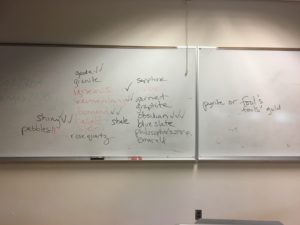
Here are the results of yesterday’s exercise responding to what turned out to be the very complex question “What’s your favorite rock?”
Michelle Wolf in Effigy: The White House Correspondents’ Dinner
As we finished our last class today, I thought it was only appropriate that I attempt to apply course concepts to an outside event. I stand a mere 10 days from finishing my time at Geneseo (as long as I survive my Capstone!), and I wanted to be sure that concepts like those presented by Joseph Roach were applicable to me outside of the microcosm of our classroom. Which is lucky, because I’ve got something on my mind. Continue reading “Michelle Wolf in Effigy: The White House Correspondents’ Dinner”
8 Blog Posts, A Semester’s Commentary
Hello, so as not to crowd the blog with 8 blog posts, I’ve condensed them all into one major blog post. I believe they function similarly to a commentary on the semester. Please enjoy. Continue reading “8 Blog Posts, A Semester’s Commentary”
Fem Future Unchained
Similar to Clio in her blog post “Janelle Monae’s ‘Make Me Feel’ and Commemorating the Dead”, I was so inspired to write a post of my own after watching Monae’s recently released emotion picture*, “Dirty Computer” (which if you haven’t taken the 48 minutes and 37 seconds out of your day to watch it, I highly suggest you do as soon as possible). Monae’s visual album is steeped in political sentiment with notions of queerness, blackness, and femininity float to the surface.
Life is Strange: The Relevance of Video Games
For my final blog post, I want to reflect and talk about video games–specifically one of my favorites: Life is Strange. I’ve gotten more into playing video games as they develop; I have noticed they rely heavily on stories rather than the simple action and gameplay. Video games are usually seen as a form of entertainment, but nowadays, I consider them almost like playable novels. Just like novels, the creators of these games can make connections and illicit messages through themes, symbols, allusions etc.
I’m discussing Life is Strange specifically because its prequel, Life is Strange: Before the Storm, references “The Tempest” in the students’ production of the play. As I found out through actually reading “The Tempest” for the first time, the presence of this reference is important for the context of the game’s storyline.
Continue reading “Life is Strange: The Relevance of Video Games”
Response to “Unpacking Caliban”
In “Echoes in the Bone,” under the “Performing Origins” heading, Roach discusses Henry Purcell’s 1688 opera Dido and Aeneas, quoting in particular the “Eccho Dance of the Furies,” where an off-stage chorus “choreograph[s] the fated catastrophe”: “In our deep-vaulted cell the charm we’ll prepare, / Too dreadful a practice for this open air.” Roach uses this example to illustrate his point that in operas of the era, “Witches, like the spirits of the dead, allowed those among the living to speak of […] the hidden transcript of succession.” Roach is referring here to the Exclusion Crisis of the 1680s, but I want to focus on another “transcript of succession”: Prospero’s seizure of the rulership of the island from Caliban. The “crisis of royal succession,” Roach writes, “is perforce a crisis of cultural surrogation, necessarily rich in performative occasions and allegories of origin and segregation,” and I think it’s valuable to focus on the origin and segregation stories that Prospero allows to be told.
Pseudohistory: A How to Guide by Kanye West
Kanye West. Everyone under the age of ~35 has heard his music at least once in their life. He is known for his musical ability as well as his outlandish personality. He has even been named one of Time Magazine’s 100 most influential people in 2005 and 2015, respectively. It is a fact that Kanye West is regarded as a dominant figure in rap/hip-hop, and his influence stretches even beyond that as indicated by the statement above. The enigma that is Kanye West has been puzzling critics and the public for years – the genesis of his mystery, perhaps, could be attributed to his vocalization of George Bush’s response to Katrina, in which he is quoted as saying, “George Bush doesn’t care about black people.” Recently, he has been making headlines again, but for a seemingly juxtaposing statement to that of his statements on George Bush. In a recent interview with Charlamagne tha God, he is quoted as saying, in regard to slavery, “[w]hen you hear about slavery for 400 years … For 400 years? That sounds like a choice.” These false comments sparked outrage from fans and friends alike, with musicians such as Will.i.am calling his remarks “one of the most ignorant statements” he could say. These comments, combined with Kanye’s influence among the public, serve to both the performance of violence as waste and the performance of memory and forgetting.
Continue reading “Pseudohistory: A How to Guide by Kanye West”
Prosperos’s Retrospection and Anticipation
People like to hate on Shakespeare for many reasons – the most common being the poetic style of his chosen diction and how the density of his syntax lacks proper clarity at a surface level. It is only when you read between the lines and look up the context of his colloquialisms that we are able to fully understand the style of his writing. I know that when I was in high school, I severely disliked reading works written by the main man of the canon; and even now, as a sophomore in college, I still shudder at the thought of analyzing A Midsummer Night’s Dream. Shakespeare may not be for everyone to enjoy per say, but it is a fact that without him, my understanding of the English language and Renaissance would be much less – he is necessary. As previously stated, his language lacks clarity on the surface; however, in doing so he successfully conveys more than one theme on each individual line. In the context of our class, “The Tempest” is representative of a contemporary lens of the performance of memory and forgetting given to us by Roach.
Continue reading “Prosperos’s Retrospection and Anticipation”
Lynching: a thread
Since several of my most recent blog posts have touched on lynching on United States soil, I’ve discovered some interested threads between my Wikipedia research and some course concepts I’ve been wanting to unpack since we first started reading Roach. One of my favorite things is when themes overlap between my classes and as it happens, I had just learned about the Exclusion Crisis with Dr. Paku a few days prior to reading about it in Roach’s “Echoes in the Bone” (44). That very day I wrote a big, underlined “BLOG POST” next to the passage, highlighted with three ginormous starts. I guess what you could say is that this post has been a long time coming.