A Look Into Sustainability In Art

By Amina Diakite, Niamh McCrohan, Abby Ritz, Corinne Scanlon, Abbie Sorrell, Brian Vargas, Brooke Ward, and Helen Warfle

Sustainability is the balance of three systems: the economy, society, and the environment. The idea of sustainability is that you need to meet the needs of people at present without compromising a possible future for other generations. The Urban Garden piece created by Steve Prince and the students and faculty at SUNY Geneseo is an example of society trying to gain such a balance. In this piece, we brainstormed about the three systems under sustainability and how they can intertwine with one another to either create enormous huge problems that we should be addressing or successes that we appreciate. One half of the Urban Garden showed the unsustainable aspects of how we currently live; but the positive half showed hope—the seeds for how balance can be restored. Continue reading “A Look Into Sustainability In Art”
Thoughts On Progress I

Thoughts on Progress I
James Ferguson

All those who have the ability to learn and experience are capable of progress; all humans have the potential to experience. In the same respect that progress is possible because all humans can learn and experience, the state and pace of progress may often depend on the environment in which one is able to learn and experience. Because of the environment one must live in, they may not be able to focus completely on their forward experiencing of life in the way they desire. Similarly, those who can enable themselves to experience may face rapid progress in their own work—that being said, I personally do not believe that an individual is completely bounded by the environment they are born into or must live in; people can have the will to overcome their respective environments. Continue reading “Thoughts On Progress I”

What the Middle Ages is teaching me about how the rich relate

I’m in Lydia Kertz’s class ENGL 466: Medieval Romance and Its Afterlives, and have found that studying the often-derided genre has developed my analysis of power and legislation of institutions that we still experience today, namely marriage, as well as how an upper class exacts power through its connections across sectors. Continue reading “What the Middle Ages is teaching me about how the rich relate”

On Dance

Dear past me,

The way I imagine you right now, it’s your sophomore or junior year of high school. You’re probably at musical rehearsal doing homework or trying to catch up on sleep between scenes, dreading having to go up on stage. After all, participating in your school musicals was more of a social thing for you — you aren’t a great singer (though you love to sing) and you’re a terrible dancer, which isn’t great considering that your school loves to do tap-based musicals. Continue reading “On Dance”

Review on Steve Prince’s “Urban Nativity”

Steve Prince is known for depicting many themes in his work; Christianity and the lives of Black Americans are two big ones.

As many of Prince’s pieces are more symbolic, this one, “Urban Nativity” is a more blunt take on these topics. Take note that Prince’s usual characteristics are still present-the block shaped pants and shoes suggest that the horsemen of the apocalypse are standing over the dead body. Symbolically, the horsemen may represent the men who’ve killed the victim. They may also represent passerby’s, who are unfeeling to the tragedy in front of them, as bystanders, they are are also responsible for this boy’s death. The dead body is only covered by a cloth, which forms Prince’s trademark dove. This dove suggest that the boy who died was innocent and peaceful, his death was a great tragedy and wrongdoing. The dove is also lying on the ground, meant to mean that peace is dead too. Lastly, a price tag hangs from the victim’s foot. This can be taken to mean many things, but I think the simple message it is supposed to bring to those viewing Urban Nativity is that a price was put on this person’s life and that the world didn’t slow down to mourn, it was desensitized to his death.

GEN『E』SEO: The Myriad of Navigating Geneseo’s Binaries [5]

The turtle, dwarf,  an amorphous blob, a teenage boy, and a dopey-looking corgi scurry up the cliff. The turtle was sweating as he carried the corgi, the dwarf followed by stoically, the blob was somehow swimming its way up, the teen had a look of terror, and the dog looked about as happy as any dog would be when they saw new people. 

The crew heard scuffling and splashing water below. The hobgoblins below were trying to get across the strong river and its currents which the team had previously managed to get across. However, as one hobgoblin tried to get onto the hill, the current below pulled them back in. The teen let out a sigh of relief as he made it the top of the cliff.

When the teen made it up, he spotted a dead pine tree; it was about 25 feet. However, its roots were dead and right on the very edge of the cliff. The teen runs over to the tree and starts pushing it; the other team members caught on and pushed with him. The corgi barks, the turtle and dwarf push with their backs, and the blob idly watches. Just as, the enemy had gotten on the cliff, the tree toppled down and onto the enemy. The setting quiets down but as the crew begins to relax, the teen spots a huge gray cloud coming north. They had gotten themselves into more trouble.

(Artwork by:  Cristina Daura)

Continue reading “GEN『E』SEO: The Myriad of Navigating Geneseo’s Binaries [5]”

Pushing Back

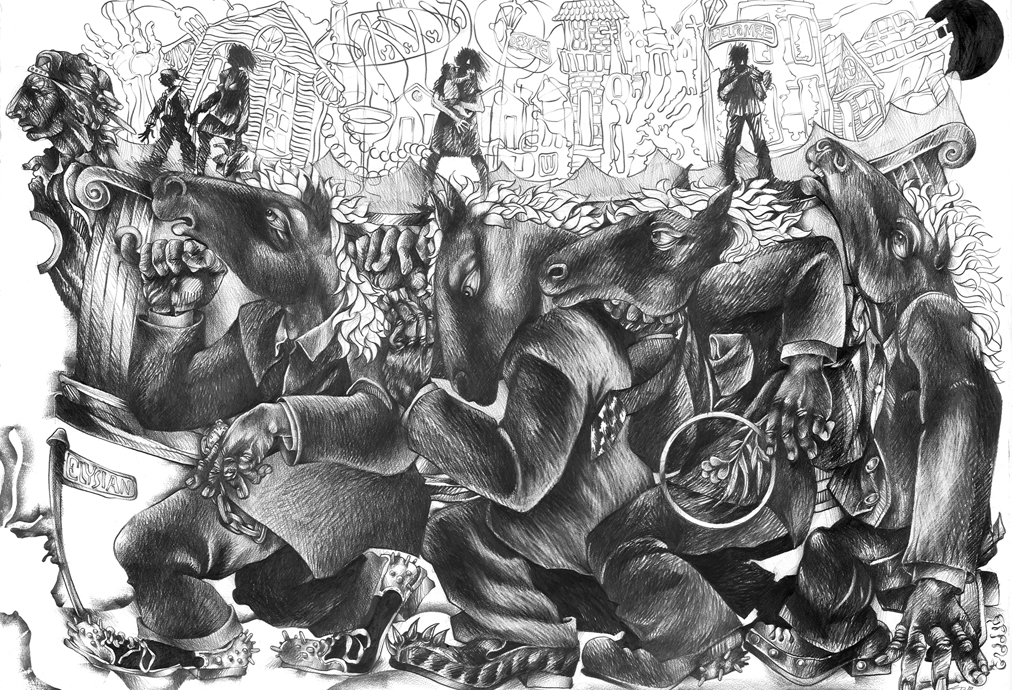
Where most of my thoughts surrounding Joe Moran’s Interdisciplinarity once centered around the manner in which language defines or informs science and vice versa, a comment from Dr. McCoy in lecture a few weeks ago caused me to look back to the art of Steve Prince and reminded me of the intersection between the humanities and sciences that occurs within many of his works. Dr. McCoy stated that she would like it if someone could explain to her the physics behind the horsemen and their carrying of what appears to be a representation of the city of New Orleans in Prince’s piece entitled, “Dirge.”

29.5″X42″ Graphite Drawing

Continue reading “Pushing Back”

Everything is Not (But Sometimes is) What it Seems

When I view artwork, I always try to find a deeper meaning. But there isn’t always an implied meaning for artwork and that is what I discovered recently. For some reason, I always try to dig deeper into artworks, my brain automatically tries to find a deeper meaning, an underlying message or hidden symbols within the artwork itself. However, while making art, I don’t think about these aspects during the creation process and I found this rather interesting. While reading some of my classmate’s blog posts, I found Melisha- Li Gatlin’s most recent post very intriguing and helped answer my thought.

She says, “When I look at art, I assume that the piece in front of me is the initial message the artist intended for the audience. Now, I am starting to realize that some art can simply be a beautiful mistake. By beautiful mistake I am referring to obstacles the artists face during the process that turn out to make the piece into something the artist had not imagined. Another assumption I make is that there is a deep-rooted meeting behind each piece of art. This assumption was proved wrong throughout the exercise as my group and I started putting colors together just for fun”

I started drafting this blog post a couple hours before Prince gave his “Kitchen Talk”, which opened my eyes to the other side of the creation process- deliberate symbols and deeper meanings embedded in artwork. But some artists don’t use this technique when creating their artwork, which is something I had never considered.

Continue reading “Everything is Not (But Sometimes is) What it Seems”