
An Appreciation for The Process

The Process

We often aim for specific results and in that desire to achieve that result, forget to appreciate “the process” or journey we took in trying to accomplish that result—people often allow the desire for a result or the disappointment from the lack of a result blind them from the wonders of process. Whatever the result is, should we achieve our desired goal or not, the process offers us valuable growth, reflection, and experience which we should appreciate just as strongly as our initial goal.

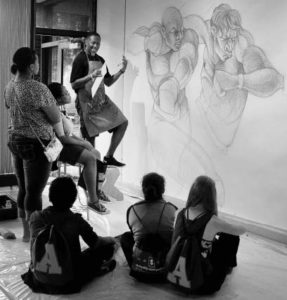
Steve Prince at Wayne State University

Steve Prince, an educator and art evangelist from New Orleans who utilizes printmaking, drawing, and sculpting as mediums to tell stories, is an individual who strongly emphasizes the benefits of the process behind a goal, as well as the growth and experience that occur with alongside this process. As a storyteller who utilizes significant historical context, his process of pasting and working context together is more rewarding than the product—of course, working with a goal in mind is important, I don’t mean any discredit to the application of goals. The interactions I have had with Steve Prince that have helped me arrive at a better understanding of the benefits and weight of the process, they include: the SUNY Geneseo Urban Garden collaborative art Project which Steve Prince facilitated at the beginning of the semester and the jazz/art collaborative work between Prince and the Freedom Trio that same week. Continue reading “An Appreciation for The Process”
What is Art?

There have been two instances where the question “what is art?” has been brought up in conversation. One instance stemmed from Dan DeZarn’s lecture where he attempted to give a definition of art, which is a piece of work that had to include craft, design, and content. Another instance was in Cynthia Hawkins-Owens’ where she stated that art can be learned. Upon hearing these statements separately, I had different reactions which I realized are opposite of each other. To DeZarn’s statement, my initial thought was his definition is too constrained. I believe that art is any form of expression; craft, design, and content will not make someone believe that a piece of work is art, however, artwork can also lack one of the three and still be considered art. On the other hand, I do not completely agree with art being something that someone can learn. Yes, people can learn to draw or paint well, but it is the intention behind it that makes it art. It was not until I started writing this blog post that I realized my opposite reactions and how these statements can actually be a both/and. Continue reading “What is Art?”

Mince My Words

“The accuracy of accurate letters is an accuracy with respect to the structure of reality.”  ~ Wallace Stevens

I mince my words, chopping them up until they are fine and small, until they are digestible, able to be used as an ingredient in a larger recipe.  When I apologize to a friend, write an email to a professor, edit a paper, I find myself cutting into the words I use turning them over and looking inside of them, picking their meaning and their implications apart until they are dissected on a little cutting board in my mind.  Perhaps this plays into some of the anxiety I have over writing, the constant questioning: What if a word is wrong or misplaced? What if I have not been careful enough? What if a word (or phrase, or paragraph, or essay, or blog) is not the right word (or etc.) for what I’m attempting to say? And while some of this anxiety over the implications of the words I choose may be misplaced, I feel that it is endlessly important to pay attention to the implications of the words and phrasing we use in both our writing and in everyday life. Continue reading “Mince My Words”

Cookbook: Part 1

The process of keeping up to date is sometimes a difficult one for me, especially regarding the blog posts for this class. Every time I have attempted to publish a post I have felt distracted by the next class lecture and/or the reading for same. There are so many elements to this course that sometimes it makes my head hurt. When I saw Prince’s work “Peace of Mind” I liked the piece at first glance that I then decided to spend some of my “free time”
with it.

Continue reading “Cookbook: Part 1”

Looking for Empathy

The following are some common examples of excuses I have heard or seen for being a casual observer of racism and other discrimination: as a person who has never experienced slavery, I don’t have the emotional range to sympathize with enslaved people or even their descendants. I will never be prejudiced against in ways that they have experienced their entire lives, so how can I possibly relate? Oh, that was a long time ago. I don’t care because I don’t know… Continue reading “Looking for Empathy”

Seeing Sound Waves (and More)

Last semester, I worked as an undergraduate lab instructor in the physics department for Dr. McLean’s “The Science of Sound” course. I thoroughly enjoyed working in this position and feel that I learned a great deal from it, not only about the science of sound but about myself, as well. While working as a lab instructor for this lab granted me new skills and a passion for instructing, it also, unexpectedly, left me with tools I can now use to enrich my interpretations of Steve Prince’s art.

For example, when I look at Prince’s piece, “Requiem for Brother John,” I am instantly drawn to what I perceive to be sound waves emanating from the trumpet in the background. These waves remind me of my time spent working in the Science of Sound Lab and of the hours I spent grading students’ drawn representations of waves for accuracy (not artistry, though some of the waves were drawn with obvious skill and flair). Notably, the waves appear curved upon their immediate exit from the trumpet and then straighten out when they reach the left-hand corner of work, as waves do upon propagating far enough out.

Continue reading “Seeing Sound Waves (and More)”

Spirituals and the Nationalistic Music of the United States

Spirituals and the Nationalistic Music of The United States

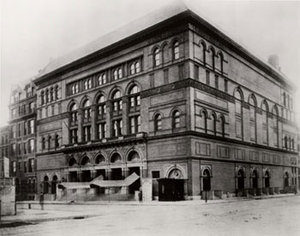
The Conservatory of Music

Alongside the early stages of the development of Western music in the Americas during the late 1800s came the global desire to establish national boundaries; music was one particular area where countries wanted to display their national pride and establish their nationality. The Americas, particularly the United States, was at an awkward stage in the development of its own nationalistic music, as it was not clearly established what “American music” was at this point. Eventually, a composer from Prague alongside the National Conservatory of Music, founded by Jeannette Meyers Thurber, in the United States would help push the majority of the country see that “American music” was to be built off the country’s foundation: the music and rhythms of the indigenous people and African Americans—this American music consists of the African American spirituals that WEB DuBois discussed in The Souls of Black Folk; this post serves to give some more context around the spirituals that emerged from traditional African songs that were passed down from the very first slaves in the U.S.

The United States – Early 20th Century

By the late 19th century, when the United States was trying to establish its own music, European music had already been established in the several countries, making the creation of their nationalistic music simple and original. American music, however, was in its early stages of development, leaving the people of the United States reliant on the more established European classical music (Grout, 2019). The study of music was also extremely dependent on European music; people from the United States started traveling to Europe in order to study music there—after placing European music at the center of music, many people then tried to imitate this music and during the era where national boundaries were rising attempted label it as America’s nationalistic music, in spite of the music that already existed in the United States. Continue reading “Spirituals and the Nationalistic Music of the United States”

Who’s Your Audience?

Upon learning that Mark Broomfield was attending one of our classes, I was excited because of my personal connection to dance. I have been dancing for years now and since being a student at Geneseo  have not had a chance to take one of his classes yet; therefore, I was anxious to see what he would teach us and how it would connect to Steve Prince’s art. We spent this class period moving around which is expected, but something one of my peers brought up inspired me to think about our everyday comfortability. In discussing the stereotypical feminine and masculine dance phrases/poses, Dr. Broomfield challenged us to push  against these stereotypes. In order to accomplish this my group decided that half of us would repeat the same sequence of the stereotyped feminine and masculine moves, and the other half would mirror the same moves but modify them to fit the other gender. The point of this exercise for me meant fighting stereotypes and becoming comfortable with being uncomfortable. Continue reading “Who’s Your Audience?”

Social Sustainability Through Art, Life, and Literature

Blog Post Written by:

Alexis Banaszak, Kazon Robinson, Madison Jackson, Mary Rutigliano, Joo Hee Park, Melisha-Li Gatlin, Devin Hogan, and Cindy Castillo

Sustainability is a definition that is not fully set in stone. In fact, the term sustainability has no self-sustained answer because of its wide and various meanings. Every person interprets sustainability differently. For some, sustainability is a matter of maintaining something to a certain level. For others, sustainability is focused on the environment and fighting for conservation matters. Generally speaking, sustainability is structured by three pillars: environmental, economical, and social and that we need all three pillars to aim for sustainability. Our group first searched the definition of sustainability and decided the definition with the best fit is from the website YadaDrop. The website defines social sustainability as “an ethical responsibility to do something about human inequality, social injustice, and poverty.” This definition strongly resembles Prince’s compositions and content. Over the entire semester our class has been filled with intellectual curiosity about what Prince tries to unpack in his work. From the pieces we have examined in class, our group agreed that there is a both/and with simplicity on the surface and multiple meanings upon analyzation.

Continue reading “Social Sustainability Through Art, Life, and Literature”

Untangling Sustainability

By Liv Binda, Sarah Bracy, Claire Corbeaux, Lindsey Kriaris, Noah Mazer, Sarah-Anne Michel, and Morgan Torre

Sustainability is a frequently used buzzword, defined as “a socio-ecological process characterized by the pursuit of a common ideal.” Almost every day, efforts are made to conserve resources on a global scale, as well as on local ones. SUNY Geneseo, for example, demonstrates a commitment to environmental sustainability through initiatives such as composting programs, hosting a campus beautification event, giving out Campus Sustainability Leadership Awards, holding exhibits that feature art that deals with issues of ecological sustainability, and launching a campus sustainability month.

In class recently, we started looking at sustainability from a wider perspective and began investigating and incorporating the three pillars of sustainability: economy, society, and the environment. The United Nations recognizes another pillar that exists outside of, yet interacts with, these canonical pillars. In our estimation, the pillar of cultural sustainability is equally as important as the other three, but is often underrepresented and rarely discussed. Indeed, Geneseo often fails to consider this fourth pillar and the role it plays on-campus: a recent email about the Sustainability Leadership Awards explicitly referred to “the three pillars of sustainability (economic, social, and environmental)”.

Continue reading “Untangling Sustainability”