The Big Short is a nonfiction book that ties the stories together of a few people who predicted the 2008 financial crisis and made massive profits from betting against the housing market. The book dives deeper into how the housing bubble was created by risky mortgage lending, subprime mortgage backed securities, and the complicity of banks and rating agencies. The book also follows the stories of hedge fund owners like Micheal Burry and Steve Eisman, who saw the potential collapse and how unaware Wall Street was of the risks. The book ultimately highlights the greed, corruption, and failures that contributed to the worst financial crisis in history. While we are analyzing the big short, we have connected it to the Human landscapes in SW Florida pictures. This is a series of photographs that all have a commonality. Within this picture essay these photographs are all of developments within SouthWest Florida. However, it is important to note that most of these developments are incomplete or partially complete. Many of these incompletions are due to bankruptcy and the partially complete are due to foreclosures. Although amongst these photos there are completed developments full of 100s of houses. You must also know that they are complete but the houses are completely empty. It is hard to pinpoint an exact reason for the financial loss within these developments, it can be assumed and connected to the concepts stated and explained within The Big Short. We will analyze these terms and what they mean Risk, Trust, Foreclosure, Mortgage, and Moral Hazard. Risk is defined in financial terms as “the chance that an outcome or investment’s actual gains will differ from an expected outcome or return.” (Investopedia). Trust is “a legal entity with separate and distinct rights, similar to a person or corporation.” (Investopedia). Foreclosure is “a legal process that allows lenders to revolver the amount owed on a defaulted loan by taking ownership of and selling the mortgaged property.” (Investopedia). Mortgage is “a loan used to purchase or maintain a home, plot of land, or other real estate.” (Investopedia). Moral hazard is “the risk that a party has not entered into a contract in good faith or has provided misleading information about its assets, liabilities, or credit capacity.” (Investopedia). Throughout this essay we will be unpacking each concept and how they connect to The Big Short and the SW Florida pictures.
Moral Hazard is a top concept within The Big Short. Many bank owners knew and did not care about hurting the working people who lost their houses, 401k plans, and money. “And that banks that used it were really just banking on being able to rip off poor people even more than they could if they charged them for their checks.” (Lewis, pp. 19-20) Risk is represented in that the economists and big finance institutions took the risk in the trading of these CDO’s. These CDO’s and the mortgages given at the time were actually hurting the people. The mortgages given way exceeded what people could pay causing most of the time for houses to go into foreclosure. During the time in which this trading was happening the money was coming in and no one could’ve expected the foreclosures that would happen by the thousands. Many of the loans that were given people couldn’t afford. A lot of houses went into foreclosure because of the loans given out. “On June 25 the total number of loans in default spiked to 18.68% percent” (Lewis, p. 197) The Big Short pays a lot of attention to the bankers and the money makers rather than talking about those who had faulted on their loans and the effects these loans had had on the people taking these loans out. The number of people who couldn’t or barely made their mortgage payments was large and it shows in the numbers. Within The Big Short mortgages were given despite evidence that they could be paid back. These mortgages were then sold from company to company as CDO’s. Economists had trust in the CDO’s they were buying, they had faith that the CDO’s would make them money. Was eager to make the most money and just did that. These shortly fell through and a crash happened and the CDO’s were no longer profitable.
Within the picture essay of the “Human Landscapes in SW Florida” At the time these developments were being built and or were built their emptiness was due to the mass of foreclosures due to the unreasonable mortgages given to people who were unable to pay these mortgages. This essay has examples of foreclosure like in pictures 1, 4, 13, 15 developments went bankrupt and had to stop construction. Also in pictures like 2,3,4,5 and so many show fully completed developments. To the eye they look full however it is stated in the beginning that most of these developments are empty due to mass foreclosures. Moral Hazard is represented in most to all of these pictures, these houses are built close to water sources like the ocean, man made lakes, or even rivers. The hazard with this is the potential for flooding, storms, or any other type of water related damages. These home owners had more care about the mortgages they were offered instead of the potential risks of being in such close proximity to water. Another course concept in this picture essay is trust in the literal sense banks granted money to these developers to build. But either the bank or developer fell through with money and they could not be finished, defaulting on their trust to the other party. It was also trusted that there would be people to fill these houses and they did. Until they could no longer make their mortgage payments. Developers took risks in building these developments with the promises they would be filled. Homeowners took risk of living near the water
Although it’s hard to make conclusions about these developments and the true story behind them by just having pictures. This is closely similar to the CDO’s in which no one truly knew what they were and it became hard to make conclusions about the CDO’s also. However, we can take the course concepts we have been focusing on to make connections between the picture essay and The Big Short. Moral Hazard is prevalent within both of these pieces for example the financial institutions that participated in the CDO trades had no care for what would happen to anything but their wallets, this carelessness led to the 2008 housing crisis. The photo essay shows the effects of the decisions of the developers and governments who made these housing lots prioritizing profit and growth, placing the weight of the consequences on vulnerable people and communities who are trying to live in these housing developments. Due to the crisis and greed of these large companies, countless homes are left vacant and thousands of people are forced to default on their mortgages.
“A giant number of individual loans got piled up into a tower.” (Lewis, p. 26) The metaphor of the tower is an interesting one, as Lewis describes that the mortgages with the lowest interest rates got paid back first and had the highest ratings. The lower floors had the lower ratings and the highest interest rates, but these floors were risky as you risked people defaulting on their mortgages. (Lewis) It was the higher interest rates that were more attractive as these mortgages would take longer to pay back making more money for those who owned the mortgages. However, the risk comes in because of the higher interest rates it makes these mortgages difficult for the payer to pay back causing in these defaults and foreclosures. The Big Short is a textual example of these defaults but the picture essay gives us picture evidence of this. In the picture essay all of these developments that are complete are empty like in pictures 16,19,21, and 22. Most of these houses in these pictures are empty due to foreclosures and defaults on mortgages. Customers trusted mortgage lenders and banks, “The subprime mortgage loan was a cheat. You’re basically drawing someone in by telling them, ‘You’re going to pay off all your other loans–your credit card debt, your auto loans—by taking this one loan. And look at the low rate!’ But that low rate isn’t the real rate. It’s a teaser rate.”(Lewis, p. 19)
There’s a quote in The Big Short on page 145 that says “The shotgun kicked and bruised your shoulder, but the Uzi, with far more killing power, was almost gentle; there was a thrilling disconnect between the pain you experienced and the damage you caused.” Although within the context of the book it is talking about guns and the shooting range, this quote applies to the whole housing economy of the time. During this time economists within the housing and mortgage industry were trading and selling these CDO’s. It wasn’t promised that these CDO’s would make any money but the risk was worth the outcome. This relates to the incomplete housing developments in pictures 1,4,13,15 of the picture essay because in the same way the economists were taking a risk in buying and selling these CDO’s banks were taking risks on developers and developers were taking risks on bankers. Bankers took the risk of writing these loans to developers to build these houses and huge developments. The more houses you have the more mortgages you can write, which means the more CDO’s you can sell and the more money you can make! Although it appears the crash and faulty mortgages caught up to the developers leaving their developments bankrupt and unable to complete.
We care because this was happening to other human beings. Customers were trusting banks and mortgage lenders to be honest and transparent with them. These banks and mortgage lenders were backstabbing customers by issuing high-risk subprime loans to borrowers who couldn’t afford them. This led to many people losing their jobs, homes that were in foreclosure, and poverty. These connections tell us about the housing market and how people interact with mortgages now because the 2008 crisis and the landscape photos taught us we must be more careful with who we give out loans. This taught the banks to be more strict about people’s FICO scores instead of giving away big loans to people with low/bad credit reports.
By: John McKiernan, Cassidy Hand, Ericeliz Carrillo, Kyle Footer, Rylie Capezzuto, and Mia Hendrickson
The images from “Human Landscapes in SW Florida” intersect with multiple course concepts that illuminate what we read in The Big Short. These concepts include liquidity, foreclosure, moral hazard, bad faith, toxicity, and expulsion. To grasp the significance of these concepts, it is crucial to understand their definitions, as many words can have various meanings. Liquidity can be assumed to be liquid, which is true in some cases, in other cases Investopedia explains how liquidity is, “the efficiency or ease with which an asset or security can be converted into ready cash without affecting its market price.” Next, as we have talked about in class foreclosure is the action when property is taken away if someone fails to pay their mortgage, Investopedia explains it as, “Foreclosure is the legal process by which a lender attempts to recover the amount owed on a defaulted loan by taking ownership of the mortgaged property and selling it.” Investopedia also describes moral hazard as, “the risk that a party has not entered into a contract in good faith or has provided misleading information about its assets, liabilities, or credit capacity.” People might understand bad faith as the intent of having an understanding that is not true. Investopedia states that bad faith is, “this can include misrepresentation of contract terms by using confusing language and unfixed rates and terms. This is purposefully done to avoid fulfilling the understood obligation.” Next is toxicity and many people understand that as something toxic or poisonous. Lastly is expulsion, oxford languages explain expulsion as the action of depriving someone of membership in an organization. Together tying the pictures from “Human Landscapes in SW Florida” and these six course concepts help us build a deeper understanding of what we read in The Big Short.
Throughout the book, Lewis repeatedly refers to the system of subprime loans as a tower, where “the top floors got their money back first and so got the highest ratings from Moody’s and S&P and the lowest interest rate.” However, “the low floors got their money back last, suffered the first losses, and got the lowest ratings from Moody’s and S&P” (Lewis, 26). In a literal sense, this relates to the concept of liquidity, something that often has a financial connotation. Furthermore, Lewis uses water to demonstrate the destruction of the subprime loan system and the subsequent economic crisis, with the lower levels of the tower—those with subprime loans—being the first to experience the flood. Although those responsible for the housing crisis claim ignorance over their actions, not all finance personnel were fooled, as pointed out by Lewis, who invokes the skepticism of Mike Burry, saying “As the value of the insurance contract changed—say, as floodwaters approached but before they actually destroyed the building—he wanted Goldman Sachs and Deutsche Bank to post collateral, to reflect the increase in value of what he owned” (Lewis, 49). Nevertheless, “In 2005, over $1 trillion of bonds like Toxie were created. It was an ocean of money flowing into the housing market, contributing to the crowds of people showing up at open houses—and to home prices that kept rising” (“Human Landscapes in SW Florida”). In this sense, the floodwaters persisted.
The aftereffect of the housing crisis is shown in “Human landscapes in SW Florida.” In these pictures, vast areas planned for development are left desolate and abandoned, a legacy of the housing crisis. The fact that the pictures were taken in Florida is significant because “First, the underlying loans were heavily concentrated in what Wall Street people were now calling the sand states: California, Florida, Nevada, and Arizona. House prices in the sand states had risen fastest during the boom and so would likely crash fastest in a bust” (Lewis, 184). Interestingly, while talking with Joel Greenblatt, Burry noted that “It became clear to me that they still didn’t understand the [credit default swap] positions” (Lewis, 191). This is significant because, unlike subprime loans and credit default swaps which were indecipherable, the Florida landscapes were optically pleasing with a clear structure and plan (often relying on basic grid structures). Although the reliance on subprime loans and credit swaps made the finance industry incredibly rich, it created immense poverty for the masses.
Acts of bad faith in the financial industry, according to Investopedia, can include using convoluted language and shady non-disclosure of policy provisions and exclusions. Insurance companies often prey on a client’s naivete and excitement in the process of purchasing their ultimate American home, achieving for themselves a steady salary while the homes sold were balanced on fragile ownership and immense risk. In Chapter 6 of The Big Short, while the reader follows Charlie Ledley, it says, “There was a thrilling disconnect between the pain you experienced and the damage you caused” (p. 145). Many of the characters indicated they understood the basic fact that something cannot come from nothing. They overlooked the collateral damage of their actions because they had so much personal profit. Moral hazard is a conscious and purposeful effort to lower one’s guard against risk because they know they will be covered if it in fact went all wrong. In The Big Short, Lewis uses the term moral hazard to describe these routine practices: “The subprime lending industry was fragmented. Because the lenders sold many–though not all–of the loans they made to other investors, in the form of mortgage bonds, the industry was also fraught with moral hazard” (p. 9). Again and again, the financial industry engages in moral hazard because they take huge risks and incur consequences they will ultimately be protected from. The same cannot be said for those who were not insured against all consequences and now face the loss of property, home, and financial security. The crash in the housing market was the result of many selfish decisions made by the various unregulated components and members of the Wall Street finance industry. Looking at Florida from above shows the gravity of what was lost due to these unregulated dealings. Countless dollars had been funneled into building homes that would never be accessible for the majority of Americans, some developments never completed and some just standing bare while an estimated 57,751 Floridians experienced homelessness in 2010.
During the housing crisis, many people’s homes would have been considered “toxic assets,” which are “investments that are difficult or impossible to sell at any price because the demand for them has collapsed” according to Investopedia. Because the housing market completely collapsed and so many Americans were in debt due to adjustable loan rates, they were forced to sell their homes back to the bank, expelling them in the process. This was because of a lack of understanding and an excess of fraudulence and corruption within Wall Street. A radio show from NPR documented their experience with the housing market, buying a house in 2005, in Florida they nicknamed “Toxie” because it was a toxic asset. This was not always the case though because “back in 2005, when Toxie was created, the housing market was booming, and mortgage bonds made it easier for people to buy houses.”(https://www.npr.org)
Though there was a risk across every state in the entire country, states considered “sand states” such as Florida were among the most affected because the “house prices in the sand states had risen fastest during the boom and so would likely crash fastest in a bust.” (Lewis p. 97) After this flood of money going into the market, a housing bubble unlike anything the United States had ever seen was created. Only when the bubble popped did “toxie” become a toxic asset, unable to sell on any market. As was the case for millions across the country, expelling them from their homes. Expelling is the act of “forcing someone to leave a place”(merriam-webster) which was evidently seen in the empty developments of houses or foreclosed homes in “Human Landscapes in SW Florida” and the article stating that “many homes there are empty and have been for years.” The toxicity from an asset goes hand in hand with the eventual expulsion of the homeowner.
Michael Lewis serves to show all the hidden intricacies of the 2008 housing crisis throughout The Big Short, directly representing the government’s neglect and abuse of the homeowners of this time. Tied with the toxie developments built in southwest Florida, we’re able to build a stronger understanding of the people’s struggle caused by their bad faith and misrepresentation throughout the early 2000s. Hundreds of thousands of people were tricked into buying toxic loans that ultimately led them to foreclosure and without any home at all. As banking industries like Moody and S&P became more and more focused on their own profit, the homeowners got washed out and forced lower and lower until they had nothing at all, as the banks specifically targeted them to take the hits first and whatever was left of the profits last. The housing industry specifically targeted the naivete of their clientele in order to enforce worse and worse policies that they themselves barely understood. This power struggle caused such a catastrophic loss that many of these victims still struggle with housing to this day, almost two decades later. Taking a look at the concepts of both the toxie developments and the Big Short endeavor to expose, we’re forced to see how the lack of regulations does nothing but favor the same industries that have only used homeowners in the past. One of the main focus points in The Big Short was how the crash was something everyone could have seen coming, had they only been paying attention. Understanding what led to the crash, and how those same practices are still in use today, and the lack of substantial change puts everyone at risk today. Furthermore, understanding the moral hazard we put ourselves in when working with these industries, as well as the bad faith they are known for allows us to move forward with a sense of security that these circumstances have otherwise taken from us.
By: Nathan Walz, Mia Hendrickson, Samantha Kim, Lauren Bieniek, Caleb Martin, Madelyn Perry
In class, we have focused on these three key terms: liquid/liquidity, swapping, and of course, expulsion. We talked about how language has multiple meanings and can be interpreted in many different ways. For example, Investopedia defines liquidity as the efficiency or ease with which an asset or security can be converted into ready cash without affecting its market price. Google, on the other hand, defines liquidity as “the availability of liquid assets to a market or company.” Interestingly, the word liquid itself also refers to “a substance that flows freely but is of constant volume, having a consistency like that of water or oil.” As for swapping, Investopedia defines swap as “a derivative contract through which two parties exchange the cash flows or liabilities from two different financial instruments.” A more general definition from google says, “an act of exchanging one thing for another.” In King Lear, these terms interact in a way that produces an outcome of expulsion from positions of power, homes, countries, and ultimately, life.
In King Lear, what marks the whole chain of events throughout the play starts at the very beginning in Act 1 Scene 1 where there is a significant swap of power. Lear, a King who is getting too old to hold power over his entire kingdom, decides he is going to divide the power between his three daughters, Goneril, Regan, and Cordelia based on how much they say they love him. This gives the first example of swapping, with King Lear swapping positions and power with his daughters. Goneril, the eldest daughter, starts off by saying to her father, “Sir, I love you more than the world can wield the matter” (1.1.60a), meaning she loves him more than words could ever describe. When it is Regan’s turn, she gives a very similar speech and it seems that the two of them may be acting in bad faith when saying their love simply because they want power over parts of the kingdom. When it gets to be Cordelia’s turn, she has a harder time overemphasizing her love for her father and says, “I love your majesty According to my bone, no more nor less”(1.1.102) She basically states that she loves the king because he is her father and not for the over exaggerated reasons Goneril and Reagan shared. In return, Cordelia gets expelled from the kingdom by Lear while the other two sisters are granted power over sections of the kingdom. Lear, having turned away his favorite daughter, Cordelia, when she did not fulfill his wish and claimed her heart could not be only for him, also cost himself his only ally. Lear utterly rejected Cordelia, disowning her from both his realm and his heart. This swap of power is the beginning of the end for King Lear.
It is impossible to trade without some sort of sacrifice. There will always be a consequence to follow as shown in the beginning of Act 3. We see time and time again that the search for power and status through liquidity and swapping only causes harm and suffering. Having been repeatedly expelled from the castle and treated worse and worse by his daughters, King Lear finds himself stranded out in a storm. Throughout scenes 1 and 2 Lear devolves more and more into a manic state, rambling and crazed. His state of mind is much like a liquid losing its form and spilling uncontrollably. He had traded his land and crown for the dream of freedom, only for it to cost him his status and power. Lear’s rapidly devolving mental state is a direct consequence of ultimately swapping his daughters for his status, “I am a Man more sinned against than sinning.” (3. 2. 62) Lear’s belief that his daughter’s “love” was something that could be traded only led to the suffering and expulsion that follows in the rest of the story. We see this through Lear and his loss of status and family, as well as Gloucester and his relationship with his sons, and the many deaths that end the tragedy. As Edmund attempts to swap himself and his brother Edgar as Gloucester’s favored son, he only serves to tear apart their lives. Initially, his expulsion of his brother, and ultimately his father does serve to upgrade his status as he grows closer to Goneril and Regan, it ends with himself and his father dead and Edgar at the top. He sacrificed everything he had only for it to turn against him in Act 5. Lear’s choice to liquidate his land was only the catalyst, as following Edmund’s fraud and the expulsion of everyone and their status we see nothing but death and pain. In King Lear, Edmund questions the fairness of existence, Lear starting after witnessing Cordelia’s death, “Why should a dog, a horse, a rat, have life, / And thou no breath at all?” (5.3.370). His early questioning of the fairness of life and status foreshadows his terror throughout the tragedy. Similarly to Lear, his selfish pursuit cost him his status, his relationships, and his life.
In comparing Shakespeare’s play King Lear to the 2008 Global Housing Crisis, it becomes ever more clear how Lear’s warning to Cordelia that “Nothing will come of nothing” (1.1.99) proves false in both the play and for those expelled from their homes. Despite the fact that the very definition of swap should make it abundantly clear that the transaction demands sacrifice to make a gain, there are points in which people are plainly and simply taken advantage of. That is to say, just as Lear sacrifices his kingdom to his daughters with the expectation that he will be able to effectively retire, there is the “fine print” of this transaction: his expulsion. His other expectation, that he is to be loved as much as his daughters first proclaim, also proves to be opposite in execution. Lear is left without that which is promised to him, thus illustrating how nothing can come from something. This experience is not unlike those of people who enter into loans and mortgages that are constructed for the sake of being confusing. The homeowners of 2008 that assumed they would be capable of paying their loans because the bank deemed them worthy of receiving said loan, like King Lear, learned that nothing can come from something- the nothing coming in the form of the loss of a home, and the something being a loan that homeowners thought they could pay off. Despite there being a clear chain of events which begins with the liquidation of Lear’s kingdom, progresses into multiple swaps of identity, and ends with total expulsion, compared to the Global Housing Crisis of 2008, the chain of events is much less capable of being organized. Ultimately, however, in both instances it is clear that despite the order in which they occur, liquidation and swapping result in expulsion.
Throughout King Lear, background knowledge surrounding concepts such as liquid(ity) and swap(ping) allows for a deeper understanding of the characters and their journeys. To consider the importance of such concepts, we need to understand their definitions, as many words have multiple meanings. Liquid may refer to one of the three states of matter, like water, for example, or could be referred to in a financial sense as “the efficiency or ease with which an asset or security can be converted into ready cash without affecting its market price” as given by Investopedia.com. Additionally, swap(ping) can simply be referred to as an exchange. Investopedia describes swap(ping) as “a derivative contract through which two parties exchange the cash flows or liabilities from two different financial instruments.” Typically, a swap also benefits both parties, something appearing highly inconsistent throughout the play. Together, the ideas of liquid(ity) and swap(ping) contribute to a central theme of expulsion among the characters and ultimately result in their demise.
The concept of liquidity can easily be applied to King Lear’s character as we progress throughout the play. We first see the concept of liquidity appear when Lear’s kingdom is divided amongst his daughters following a confession of their love. Cordelia, unlike her two sisters, stated her true feelings for Lear, stating, “I love your majesty according to my bond no more nor less (pg 13).” Her statement of truth is far from Lear’s expectations, and as a result, she is stripped of her inheritance and banished from the royal family. Cordelia experiences losing the liquid assets of power and land through her profession while her sisters prospered. Although the definition of liquid(ity) does not apply in a literal sense to land nor power as neither can be converted to cash quickly, however, both land and power are assets that have high demand amongst Goneril and Regan, a factor outlined by Investopedia when defining a liquid asset. As readers, we can also analyze how quickly both power and land are given and taken away from the characters, fitting a more literal sense of liquid. Additionally, the transition of power from Lear to his daughters also represents a loss of his power and land and would result in Lear’s character experiencing a dramatic downfall. Following the transition of power, we can see Lear’s character breaking down and we can express the definition of liquid in a more literal sense. We see the effects of the transition following Lear’s expulsion from the homes of Goneril and Regan, which leaves him stranded in a storm. From a broader perspective, the storm represents Lear’s world falling apart; he once had all the power, he had his land, and he had the affection of his daughters, which was found to be insincere. The storm can then be classified as a sense of hopelessness; each raindrop may feel like a tear. “But yet I call you servile ministers, that have with two pernicious daughters join’d your high engender’d battles ‘gainst a head so old and white as this. O! O! ’tis foul!” (Act 3 Scene 2). (The punctuation allows you to envision.. something like that) From Lear’s speech, you can almost hear the pain in his voice; the storm expresses his feelings perfectly and shows how much has changed in his life after distributing his land and power to his daughters.
The liquidation and redistribution of King Lear’s Kingdom introduces the Medieval concept of the “wheel of fortune.” Each person assumes their place along the wheel of fortune, where the fortunate will one day find themselves desolate. The wheel of fortune also intermixes with the concept of fate—regardless of how much a person resists, their position along the wheel is impermanent. As the play progresses, King Lear’s circumstances become increasingly more unfortunate. This trend is alluded to in Act 2, Scene 2, where Kent comforts the disgruntled King—who recently expulsed his daughter, Cordelia—bidding him farewell, saying, “Fortune, good night. Smile once more; turn thy wheel” (page, 95). Although, from this point forward, King Lear did not receive fortune, his wheel did turn. It is perhaps ironic that it is only when King Lear is reunited with Cordelia that he states, “I am bound Upon a wheel of fire, that mine own tears Do scald like molten lead” (pg. 217). It seems as though King Lear is alluding to his excruciating cycle along the wheel of fortune. An inverse example involves Edmund, the disenfranchised bastard who found himself atop the wheel of fortune and on the precipice of King Lear’s Kingdom. Nevertheless, toward the end of the play, seeing his machinations crumbling before him, Edmund finds himself once more at the bottom of the wheel, “The wheel is come full circle; I am here,” again highlighting the impermanence of fortune (pg. 249).
Following Lear’s misfortune, we see a behavioral swap that follows the swapping of power among his daughters. Most importantly we follow Regan and Goneril, who once obtained the land and power they wanted, revealed their true selves. Did they really love Lear? After being expelled from the homes of Regan and Goneril and watching his life spiral out of control, we can see how quickly their “love and affection” became a burning hunger for power. Following his expulsion, Lear also experiences a major character swap, and we see this within the storm he is caught in as King Lear experiences a change of heart as he begins to recognize the struggles of the lower class and how he had dismissed these and should have been a better king. We see this new Lear following his interaction with poor Tom which we know as Edgar who swaps his identity in light of a manhunt for him. Through their interaction, Lear states “how shall your houseless heads and unfed sides, your looped and windowed raggedness defend you from seasons such as these? O, I have ta’en too little care of this” (pg. 137). It is interesting to note that instances of swapping—whether it be a swapping of fortune or identity—are followed by moments of clarity. At their lowest points along the wheel of fortune, both Edmund and King Lear find clarity—Edmund recognizes his position along the wheel (“The wheel is come full circle; I am here), and King Lear realizes his neglect of the impoverished. In “King Lear”, liquid(ity), swap(ping), and expulsion all come together to show how chaotic and unstable things become when power and loyalty are constantly shifting. Together, these themes highlight the instability and treachery that come with the pursuit of power and the breakdown of family bonds. In deciphering why these concepts matter concerning the play, many people ask themselves so what? Who cares? When answering this question, it is beneficial to incorporate the benefits of outside information into your thinking in the context of reading. Within King Lear, the definitions of liquid(ity) and swap(ping) all offer a sense of complexity amongst the characters, and we can analyze their journeys in a broader context which allows us, the readers, to interpret scenes in a more meaningful way. Lear, after giving his land to his daughters, lost his power, and eventually, his daughters which then contributed to the lives of those around him changing indefinitely. Each character’s personal experiences speak for themselves, following the transfer of power, we saw many characters swap their identities, with some characters gaining in the short term and all losing in the long term. The story of King Lear emphasizes the importance of applying outside knowledge to the context of our reading. Through the concepts of liquid(ity) and swap(ping) we got to know each character and followed their journeys as the concepts listed before affected the lives and outcomes of the characters within the play.
By: Maggie Kiernan, Cole Kominiarek, Sarah Lyons, Jordan Welker, Nyna Garduño, Abbigail Woodworth
King Lear is a Shakespeare play that is a tale of power, love, deception, and mental rage. It all starts when King Lear decides to divide his kingdom among his 3 daughters; Regan, Goneril, Cordelia. However, these divisions aren’t of equal amounts of land and he must decide which daughter is more worthy of the biggest plot of land. King Lear determines that he’ll divide his land by simply having the girls express their love to him, and whoever loves Lear the most gets the biggest piece of land. Regan and Goneril are first and second to express their love. Their expressions are extravagant and feel a bit scripted. However, Lear loves their expressions and hopes Cordelia’s expression will be similar to that of her sisters. Cordelia is quick to disappoint her father as she says she doesn’t need words to show how much love she has for her father. She expresses that her love for her father is more than a scripted extravagant tale. Lear is enraged by her response and expels her from the kingdom to never return. With Lear’s beloved Cordelia expelled he is left to divide the kingdom among the 2 remaining daughters; Regan and Goneril. Regan and Goneril love their newfound power and kingdoms. However, they don’t enjoy their father being around. So they each expel their father from their kingdoms, giving Lear to the outside and casting him out of his own and known society. During Lear’s time in the elements, side character Edmund the bastard child of Gloucester is up to his own scheme. There’s someone in Edmunds way; Edgar. Edmund falsifies a letter from Edgar which gets Edgar expelled. Edgar becomes unrecognizable and is referred to as Poor Tom to the community. As the storyline continues Lear’s mental state continues to deteriorate and war breaks out. Regan and Goneril start to fight over Edmund. Edmund and Edgar fight because of Edgar’s need for revenge on his brother for what he did to their father. Then in true Shakespeare fashion the ending is bloody and full of death.
In King Lear the concepts of liquidity and swapping are apparent. Liquidity can be defined in multiple ways. One definition that correlates to King Lear is liquidity in relation to how efficiently assets can be turned into cash. The more general definition is liquidity in the sense of a free-flowing substance, like water. Another concept that is important to the play is swapping, which can be defined as the exchanging of something.
Liquidity and swapping interact with King Lear. Throughout the play, swapping represents the multiple shifts in power from inferior to superior or vice versa, as well as swapping of characters, and swapping of emotions. Swapping is shown when Edmund forges a note and pretends to be Edgar, which concludes in Edgar getting expelled. Another example of swapping of characters is when Edgar swaps to poor Tom when he gets expelled. King Lear’s position of king gets swapped to nothing when he is expelled by his daughters. Swapping is also shown in the play as a swap of powers. For instance, Lear’s power is swapped into the hands of his two daughters, Reagan and Goneril. Swapping of emotions is shown by King Lear and Cordelia. Cordelia is the favorite daughter at the beginning of the play, but once she says she does not need to express her love through words, she turns into the least favorite. The swap of emotions also occurs with the daughters and King Lear. The daughters express their love for Lear to inherit his power, but once they gain his power, they kick him out. It seems as though the love they verbalized is swapped to nothing when they allow Lear to be expelled. As there are many examples of swapping in King Lear, liquid(ity) is also a key concept expressed in the play. Liquid or liquidity can have a literal or metaphorical meaning and both can be seen and expressed throughout the King Lear play. There are specific ties to the literal meaning of liquid in many scenes throughout the play. Some of these examples can be found when Cordelia cries when she receives news that she was being expelled by King Lear as well as Gloucester crying over Edgar and losing his eyesight. Another example of the literal definition of liquid in use would be the big storm in Act 3. All of these interactions seem to be tying back in the concept of physical liquid representing either a change or sadness in the storyline. The metaphorical meaning of liquid is also often referenced through examples in the play. Specifically from the beginning of the story to the end there is an ever-changing shift in the mental state and thinking of King Lear. We believe this is a representation of the concept of liquid being unpredictable and ever-changing.
Both liquidity and swapping interact with expulsion throughout King Lear. Throughout the play, swapping interacts with expulsion in many ways. The extreme situation of the swapping of powers between the daughters, Reagan and Goneril and King Lear results in the expulsion of Lear from his once owned kingdom. Lear begins the play with all of the power. As Lear divides the power between his two daughters, he is left with none. Expulsion connects to swapping as Lear gets expelled by his daughters when he no longer holds power. Lear gets expelled and left in the storm outside with no power remaining. Liquidity has a connection with expulsion throughout many instances in the play. But a major concept of the play being the division of King Lear’s kingdom between his daughters ties into liquidity. According to investopedia liquidity refers to the efficiency in which an asset can be converted into cash. This has a connection to expulsion because the division of the kingdom can be viewed as Lear’s way of getting rid of his assets and responsibilities and in turn expelling himself from the kingdom and his duties as king. Another way this connects to expulsion is one of the daughters will not be receiving the kingdom therefore being expelled.
This exercise raised many questions relating to the similarities between King Lear and the 2008 housing crisis. During the 2008 housing crisis big banks were carelessly granting loans to under qualified people, this led to a housing bubble that collapsed and ended up backfiring on both sides. Due to King Lear’s carelessness when dividing his kingdom to his daughters who were under-qualified, he ended up alone with no resources. We can relate this to the swiftness of homeowners when applying for a NINA (no income, no assets) loan. These homeowners were granted loans that they knew they would never be able to pay off inorder to delay being foreclosed upon. After reading King Lear we were able to relate these loans to the two daughters of Lear having no true love for their father, but with a simple short talk where they lied about how much they loved him, they were given half of the kingdom. This again brings up the NINA loans where people who normally wouldn’t qualify for large loans were getting them with no questions asked. As the play continued King Lear’s mental state continued to decline due to his expulsion not only from the “love” of his daughters but also his power. We can also relate his declining mental state and his distress to how residents of homes reacted when they were being foreclosed upon. When reading future texts that may seem like they have no similarities to the housing crisis, we can think of the questions raised in this exercise and use them while reading to help us spot the similarities right away. After this exercise, anytime someone in power acts a certain way we can be conscious of how his or her decisions will affect their outcomes.
by Lily Gallagher, Ava Patelli, Brenden Harrington, Jayden Prashad, Joseph Latella, Lily Scobbo, and Zachary Simons
Looking at the terms liquid(ity) and swap(ping) in the context of King Lear brings literal and metaphorical definitions to the story. King Lear tells the story of an aging king ready to retire his kingdom. He decides to split his kingdom between his three daughters – Goneril, Regan, and Cordelia – based on their professions of love. When Cordelia refuses to exaggerate her love unlike her other sisters, Lear expels her from the inheritance. Shortly after, Goneril and Regan betray Lear and strip him of all power. Parallel to this storyline, the play also follows Gloucester who is betrayed by his illegitimate son, Edmund, and suffers greatly. Throughout the story, Liquid(ity) is present particularly concerning power, loyalty, and the nature of relationships. As we see in the play, The storms in the play serve as a metaphor for emotional and political turmoil. The chaotic weather mirrors the instability of Lear’s reign and his relationships, emphasizing how external forces can disrupt the balance of power and sanity. We also see swap(ping) in the story which can be defined as exchanging, bartering, or trading, one thing for another. After initially professing love for Lear, Goneril and Regan swap their outward displays of affection for ruthless ambition. Their betrayal of Lear highlights the swap from loyalty to treachery. In King Lear, the themes of liquid(ity) and swap(ping) manifest through Lear’s tragic decisions and the fluid nature of power. Lear’s initial control over his kingdom symbolizes financial liquidity; he easily redistributes power based on his daughters’ declarations of love. However, as he descends into madness and loses authority, this liquidity evaporates, illustrating how quickly one can lose power and respect. The act of swapping is evident as Lear trades genuine affection for the illusion of loyalty, leading to betrayal and tragic consequences. Ultimately, the play explores liquidity, expulsion, and the swapping of relationships.
Swapping, liquid, and liquidity are all very different terms with meanings that cover a vast majority of topics. In the play King Lear these terms interact with each other constantly, The idea of liquidity and swapping are both brought up in the action of losing or gaining power. In the play we see Edgar who started out as a favored son turns into a crazy beggar and is removed from the kingdom almost entirely. On the other hand Edmund starts out as the bastard and casted out by the kingdom slowly works his way into the top and gains his power, but in the end his hunt for power ends up getting him expelled from the kingdom. The action of losing or gaining power is the main idea of the interaction between swapping and liquidity not just in this example but throughout the entire play. A wheel of Fortune is a great example that Beth mentioned in class on September 11, 2024. Lear, who started out as the king and ruler of his kingdom, took a spin on the wheel, divided his kingdom to his daughters and in turn gave away his power. We would later see Lear lose his sense of reality and spiral into a deep madness, losing all of his fortune and now with none of the power he once held. This same wheel can be used to describe the journey of many of the characters in the play, some starting with power and losing it as the wheel begins to spin, while others start with none but gradually gain it throughout the play. We also follow Edgar, true son of Gloucester, who is deceived and lied to. Edgar again loses his power and swaps places with his half brother Edmund, both Edgar and Edmund are examples of swapping. Edmund swaps his brother’s trust in him for his personal ambitions and gains, while Edgar is deceived and casted out, forced to change his identity. This example is not only showing swapping but also the liquidity of relationships, where loyalty can quickly change.The bond between Regan and Goneril is marked by a deceptive fluidity. They begin as allies, but their relationship becomes increasingly competitive. As they swap accusations and manipulate each other to gain favor, their sisterhood becomes strained, highlighting the liquidity of familial ties when power is at stake. The action of someone losing power seems to be followed by another gaining said power. Swapping and liquidity are two terms with definitions that seem to interact with each other in almost every aspect of the play, demonstrating this relationship between losing and gaining power.
Pulling out direct dialogue from the text we can begin to paraphrase the most important way King Lear makes connections between liquid(ity) and swap(ping) and how that relates to expulsion. The first example of this is when Lear states, “How, nothing will come of nothing.” – Lear begins the play by asking his daughters to declare how much they love him. His youngest daughter Cordelia has “nothing” to say. This line is Lear’s response. His repetition of the word “nothing” introduces an important theme of the play. Lear will be stripped of his kingdom, his power, and his family, and left with nothing. King Lear asks whether there is anything to be learned or gained by the experience of having nothing, or whether, as Lear says here, nothing comes of nothing. Later in the text, we hear, “O, reason not the need! Our basest beggars are in the poorest thing superfluous; Allow not nature more than nature needs, Man’s life is cheap as beast’s” – The line foreshadows that Lear will soon be living side by side with the “basest beggars.” One of the central themes of King Lear is the question of whether poor and powerless people can live with meaning and dignity, or whether wealth and power are the only things that make life bearable. The next deep connection between the themes of Lear comes from Edmund as he states, “Brother, I advise you to the best. I am no honest man if there is any good meaning toward you. I have told you what I have seen and heard, but faintly, nothing like the image and horror of it. Pray you away.” (Edmund, Act 1 Scene 2). This illustrates the connection between Edmund and the expulsion he casts upon his brother by wishing to be able to pray him away after swapping roles with his brother. “I am a very foolish, fond old man, Fourscore and upward, not an hour more nor less; And to deal plainly, I fear I am not in my perfect mind.” – Lear begins the play blind to the reality of his position. He believes he will always be a king, even if he gives up his power. Over the course of the play, he discovers his mistake. Finally, he learns to see himself clearly, and in this speech, near the end of the play, he is able to describe himself accurately. In Lear’s realization, “I am a man more sinned against than sinning.” In this moment of clarity, Lear reflects on his loss and the expulsion from his former self. He recognizes the depth of his suffering and the misguided nature of his previous authority. He starts to understand the damage he is doing and how his life is based on wealth and status. After he lost everything and gave up his kingdom and wealth, he realized he didn’t have much meaning to anything or anyone. Clearly, he realized this too late as he went insane and lost his family.
We may relate to the themes of liquidity and swapping in “King Lear” because they mirror our own issues with authority and fraud. We are prompted to reflect on how we handle our own lives by the play’s portrayal of power relations, which are a reflection of real-life interactions. Empathy is sparked by Lear’s journey into insanity, which serves as a reminder of the emotional complexity of personal failings and family relationships. What happens when we lose sight of our principles; such as leaving a friendship you had for years, emotions and drama can come up from that. Considering these topics prompts us to consider crucial issues such as how we manage loyalty and disagreement in our own relationships. What may we infer from Lear’s mistakes? Shakespeare’s creativity is made stronger by these reflections, which also encourage us to think critically about our own decisions and experiences. In conclusion, King Lear powerfully illustrates the fragility of authority and human relationships through the themes of liquidity and swapping. Lear’s initial ability to fluidly distribute power among his daughters represents financial liquidity, but as he descends into madness, this liquidity evaporates, highlighting how quickly trust can be lost. The act of swapping is evident as Lear exchanges genuine love for flattery, leading to betrayal and tragic consequences. Ultimately, the play reveals the dangers of misjudgment and the profound repercussions that arise from trading meaningful connections for superficial gains, leaving a lasting impact on both characters and audiences alike.
Some months ago, I wrote about the various ways in which the inherent social construction of race and the lived realities of race interplay in The Fifth Season. I dubbed this phenomenon the existential paradox of race, and defined it as the “conflict between the fundamental nonexistence of race [and] the salient effects of race in function”, arguing that race in Jemisin’s story deliberately differed from race in the real world in order to encourage readers to reflect on their own conceptions about race. Somewhat inspired by the critical race theory texts I was reading for another class at this time, I found myself understanding more about how race was manufactured in our world, and saw similar patterns within The Fifth Season. In brief, I argued that Jemisin presented the racialization of orogenes (humans with the ability to manipulate seismic events) by non-orogenic humans with three key distinctions to traditional conceptions of race in the real world: the lack of genetic basis for inheriting orogeny, the absence of any homogenous culture within orogene populations, and the outward discrimination towards orogenes, a much more clear-cut discriminatory culture than the subtle subjugation in our reality. In differentiating her created race from our modern conceptions of race as geographically & genetically relevant and more or less determinable by appearance, Jemisin’s world communicates that there is no reality or truth in how races are created and determined, but that they are a product of arbitrary classification criteria. Our world chose to care about skin color and – to a lesser extent – geography when creating the races in our zeitgeist, the world of The Fifth Season chose orogeneity. Neither of these classifications are accurate or necessary ways to group people, as both are just as absurd and arbitrary as the other.
As I have read the other works in this trilogy, my opinions on the central method Jemisin demands the reader introspect on the existential paradox of race has remained, but it has been applied in different ways to different groups within the world she has created. This expansion of the strategy she uses follows the central strategy of separating racialized traits in the book from racialized traits in real life, but the specific traits may change based on the group being racialized. Whereas orogenes do not share any specific features or genealogy, and this is the vector through which the arbitrary classification of race is elucidated for this group, the stone eaters are, in part, grouped by their behavior and elusive origins. The stone eaters are a group of sapient statues entirely made of various kinds of stone, and are few in number. While the appearances of stone eaters are, of course, very distinct from those of any other peoples in the world, the ways other characters within the text speak of stone eaters indicates that this difference in appearance is not the primary trait that leads stone eaters to be othered. When characters describe stone eaters, their behavior, speech, and mystique come up quite often. The way stone eaters speak without moving their mouths, their inscrutability of expression, and their movement are all reasons they are described as “uncanny” and “so like humanity and yet so wildly different” (The Stone Sky, p. 27). In distinguishing stone eaters from other peoples through their atypical behaviors and the lack of general knowledge about them from the public, it seems to me as though Jemisin is exploring how culture and behavior can be used to judge personhood, and thus racialize. When Hoa – a stone eater – and Essun – and orogene human – encounter a stranger who seems as though he “maybe didn’t quite believe” in the existence of stone eaters, the man addresses Essun with a “hi” and Hoa with a nervous “uh, hi I guess?” (The Stone Sky, p. 162). This interaction stuck out to me, as the man seemed to not know if he should address a stone eater as he would another person, even one he knew nothing about. Stone eaters seemingly fall so far outside traditional conceptions of humanity that interacting with them is a challenge to non-stone-eaters, which can only serve to widen the divide between them.
Another group to which Jemisin implores the reader to introspect is the Niess, a group designation for peoples of the Niess kingdom millennia before the events of the novel. In The Stone Sky, the narration often offers a glimpse of a world back before there were orogenes or stone eaters, but far from an unracialized world. These sections are told from the perspective of a tuner, an artificially created group of sapient humanoids with the ability to “tune” to esoteric obelisks to provide power to their kingdom of Syl Anagist. Tuners hold many human traits, superficially and internally, but are also intended to lack emotion and human experience (The Stone Sky, p. 211). While these facts are themselves reflective of a gross denial of personhood from Syl Anagist, to understand Jemisin’s correlation to racialization requires a look at the history of this society. Syl Anagist was a growing superpower before this time, and eventually came to control all but one land that housed the Thniess people (whose name was bastardized to Niess due to mispronunciation). The Niess could be described as hedonistic, and in their love for life and art, they were able to create technology far more efficient to those of Syl Anagist. Syl Anagist, in their belief that their society was inherently superior, saw this technology far exceeding their capabilities being used simply for art, and in an effort to reaffirm their superiority, killed nearly all of the Niess (The Stone Sky, p. 209-211). Now, the Niess were a short-statured, kinky-haired people with nearly colorless white skin, and when Syl Anagist turned against them, even as the few remaining Niess were scattered and assimilated into various cultures, these traits were reviled by those who saw the Niess as an undesirable race of people. When describing the appearance of the tuners, however, these features of the Niess are described, and seeing as the appearance of these artificially created humans cannot be anything but intentional, the tuners were clearly intended to be perceived as part of the subjugated and discriminated race of the Niess. Despite being artificially created, with no relation to the Niess in origin, the tuners come to understand how the world perceives them despite this: “to them, we are [Niess]” (The Stone Sky, p. 257). Again, Jemisin separates the racialized peoples in her text from traditional conceptions of how race operates. The question then is raised: what is the purpose of appearance-based race categorization in a world where such features may have no connection to any peoples or groups to which a race typically refers? In Syl Anagist, there is an answer – to justify the subjugation of the tuners and the genocide of the Niess – but how the subjugation of the tuners works when they do not and cannot have a race ties back to the existential paradox of race. Syl Anagist’s manufactured race of tuners almost embodies this thought, a group that cannot be related to any existing race, but still – very intentionally – feel the effects of their racialization by society.
Upon reflection, my take on the way this trilogy has handled racialization has not changed significantly. From the beginning, I felt that Jemisin was encouraging readers to understand that the racialization of a people is only ever a reductive classification based on arbitrary traits. Race is not something that exists and thus can’t be reduced to any number of traits a person has, but race is absolutely something one can experience in a racialized society, regardless of the traits a society chooses to associate with a group of people. The existential paradox of race will always exist as long as society chooses to racialize people. In fact, in my sameness of thought as the trilogy progressed, I don’t believe that it was too terribly important for my opinions to change on this matter, especially when the way Jemisin’s handling of racialization in the first text was so inspired. The way Jemisin portrayed the racialization of orogenes in The Fifth Season was incredibly poignant, especially in her separation of skin color and genetic factors from the orogenes. Showing how people who, in every sense other than an innately bestowed ability, are just like everyone else in the story in their diversity of culture, ancestry, and appearance but were subjugated so intensely for a trait which society deemed undesirable was immensely affecting for me as a reader. I wrote about how when orogenes are forced into a group, there is no cohesive identity, as orogenes can be just as culturally and socially distinct from one another as orogenes and non-orogenes. Reminiscent of the ways in which the slave trade served to group people across the African continent who all had unique cultures and identities under a single banner because of their skin color, the orogenes likewise were never one people, but various peoples who happened to share a trait their society chose to essentialize. While the analysis of the stone eaters as a manufactured race does merit discussion, as with the purposeful likening of the tuners to an undesirable race, the cultural dissonance present between orogenes communicated to me that a single trait does not and cannot embody or define a people. Despite orogenes having no collectivity, no meaningful commonalities except being victims of prejudice and intense reprehension, they are grouped into one people, one race by larger society, and this assumption of a collective “other” allows people to hate collectively. This is the foundation of racialization, and is embodied so clearly and poetically in just the first text of this trilogy that Jemisin was able to capture my curiosity and command introspection with how well the racialization of orogenes provoked reflection on the existential paradox of race.
The Water Cure by Percival Everett centralizes on Ishmael Kidder’s experience after his young daughter Lane was raped and murdered. The Water Cure has an extremely unique structure and style. Some sections are composed of a traditional narrative form. Other sections are not written in English or are misspelled. Some are riddles or drawings, and there are countless other forms. The Water Cure was introduced to our class as a book of “may or may not”s which prompted an investigative journey as I waded through the structure, style, and story. For me, the prompt had boiled down to ‘what is real in The Water Cure?’ and ‘what is not real in The Water Cure?’ In the back of my mind was the nagging idea of ‘what if both are true at the same time?’ I dismissed the idea when most of the secondary questions were based on assumptions that it was real. This reflection led me back to the excitement and overly complicated thought processes involved in ‘may or may not’— ‘real or unreal’—and ‘why not both?’
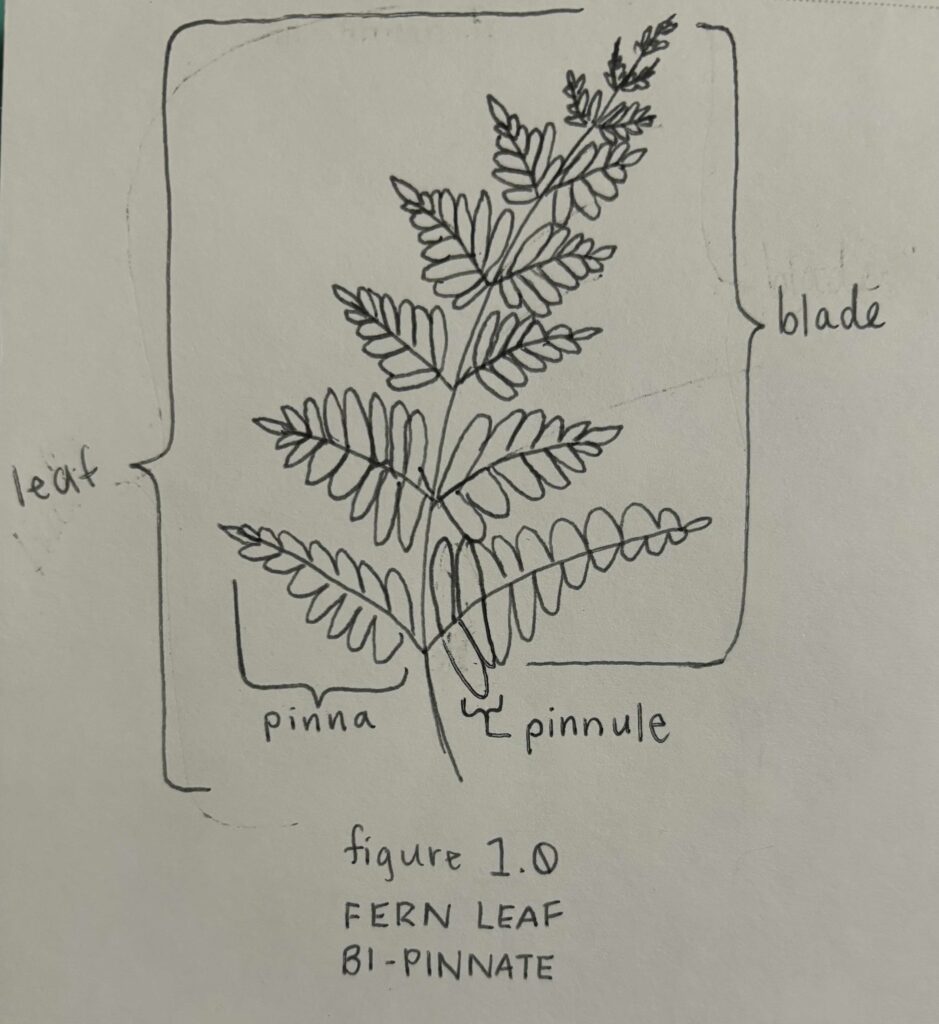
In African Fractals, the author, Ron Eglash, introduces the idea of “scaling shapes.” Eglash explains ‘scaling shapes’ as “similar patterns at different scales within the range under consideration.” (17-18) Essentially, the largest example of the pattern/shape will still look similar to the smallest version of the pattern/shape and vice versa. For example, consider a bi-pinnate fern leaf. The shape of the pattern repeats on different scales—the blade and the pinna (the first division). [fig. 1.0]
The blade and the pinna form the boundaries of the range, which Eglash references because there is no example of the pattern/seed shape that is larger than the blade and no example that is smaller than the pinna. [pattern/seed shape fig. 1.1]
While Eglash applies the mathematical concept of scaling shapes (an aspect of fractals) to African culture and life, scaling patterns can also be applied to literature. At the beginning of the semester, our class discussed the Western storyline pattern of ‘order –> disorder –> order restored’ [fig. 2.0].
On the largest scale, the story begins in a state of order (calm/stability), then something occurs that creates disorder (problem/chaos), and then (typically, the main character) seeks to restore order; once order is restored, the story ends. Within each of these overarching phases, there can be found ‘mini-stages’—smaller scales—of the overarching pattern [fig. 2.1].
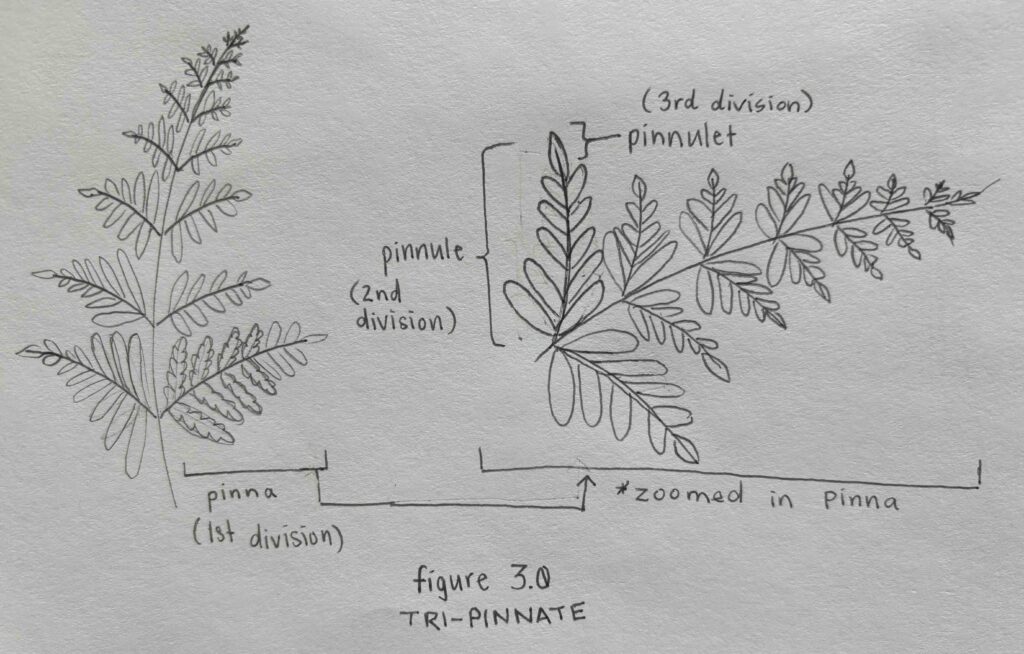
Hypothetically, this pattern could be nested infinitely, each recursive iteration being identical to the previous. Eglash calls this exact replication of pattern “exact similarity,” in which a replica of the whole pattern can be found within any smaller section of the whole (often referenced as scale invariance). (Eglash, 17) While exact similarity is mathematically and infinitely possible, in reality, as patterns repeat, they can become continually dissimilar with each subsequent iteration. Consider the fern again, but instead of a bipinnate—having two levels of division—it is a tripinnate (also called a 2-pinnate-pinnatifid)— having three levels of division [fig. 3.0].
Photo of the pinnulets of a Broad Buckler Fern (credit: Nature Spot)
The shape of the blade and the pinna (the first division) look similar. The pinnulet (third division) looks a bit different from the first division. The pinnulets are blunter and rounder. With each subsequent division, the shape looks less and less like the original. Hypothetically, suppose there is a fern with a fourth, fifth, and sixth division, each iteration being proportionately wider and blunter than the previous division. Each division would look just a little bit different than the previous. Comparing the sixth division to the first division would look nothing alike, yet they originated from the same plant and form the range of the scale. In this case, self-similar scaling morphs into dissimilarity as the range continues until the finite boundaries.
Consider self-similarity (or dissimilarity) scaling in the context of The Water Cure, with the scaling factor being size and realness. ‘Realness’ in this context refers to how likely these aspects are occurring/ could occur in the physical world that Ishmael Kidder lives in, assuming he lives in a world similar/ identical to the actual world (the reader’s world); and thereby, how likely readers are to assume it is real (occurring in Ishmael’s physical world). Audrey Taylor and Stefan Ekman described this as the “primary world” in their article “A Practical Application of Critical World-Building.” They define a primary world as “a fictional version of the actual world, with only minimal differences, a ‘simulacrum’ of the actual world” (3).
Sections and details within The Water Cure vary in their perceived ‘realness.’ For example, one section that would be very ‘real’ is when Sally, Ishmael’s agent, goes over to his house, and they converse about how Ishmael won’t eat food from restaurants, and she asks him why there is a wad of duct tape on his mantel. The section is structured as dialogue and description. A scene identical to this could happen within the actual world and not be out of place. Thereby, this scene would quickly be presumed to be real.
Alternatively, a section that is not real (yet, complicatedly, exists within the book, so it is actually real within the audience’s reality) is when the text states:
The blue house on the corner is synonymous with the house on the corner is blue. She makes everything beautiful is not synonymous with everything beautiful she makes.
(Everett, 133)
While the statements are possible—there could be a blue house on the corner; there may exist a ‘she’ that makes everything beautiful—the section is not directly linked to the primary world. Like many sections in the text, it’s not exactly certain who is stating, thinking, or saying these statements of possibly fact, logic, and/or wordplay. While the previous scene occurred within the external primary world, there is no reason to assume that this second section occurs directly within the external primary world. Thereby, it is unreal. These two sections are extremes that help form the boundaries of the range from ‘real’ to ‘unreal.’
Traditionally, scale interacts with size. In the case of exact similarity, the shape/pattern remains the same while the size changes. The range is defined by size. The size of the division is directly linked to its sharpness/bluntness—largest/first division: sharpest; smallest/last division: bluntest—meanwhile, the range of the ferns scale becomes predominantly focused on sharpness/bluntness as the shapes become increasingly dissimilar with each division, but size still plays an important role. Consider the question, ‘is the fern sharp or blunt?’ The answer would vary based on scale—is it the blade, pinna, pinnule, or pinnulet? In The Water Cure, size and realness interact differently than in exact similarity. The size refers to the levels the text exists as—the book as a whole, a section, or a detail within a section. It is possible for different details, all within one section, to fall somewhere along the scale of ‘real’ and ‘unreal.’
These varying scales can lead to questions of ‘is this section real?’ even if it’s composed of details that the reader deems to be ‘real’ and details they consider to be ‘unreal.’ It is up to the reader to decide which details are real or unreal and how scaling aspects of realness interact and determine the overarching realness. The scaling patterns call into question the state of the book as a whole, ‘is the book real or unreal?’ much like the question of ‘is the fern sharp or blunt?’
As readers encounter The Water Cure, they determine their interpretations of what is real and what is not real. Each determination builds upon the last and shapes their understanding of the book. This process of definite determination, ‘either real or not real,’ is a common approach within our society. For instance, at a restaurant, if the waiter were to ask, “would you like salad or soup as your side,” the expectation is to choose only one option. This context refers to the exclusive form of the word ‘or.’ The exclusive ‘or’ means ‘one or the other, but not both.’
However, the inclusive form of the word ‘or’ refers to ‘one or the other or both.’ In formal Logic, a branch of philosophy, an ‘or’ statement (called a disjunction) utilizes the inclusive form of ‘or.’ I took a course on logic this semester that, upon reflection, I believe helped me to reconsider the question of ‘may or may not.’ Most everyday contexts in society (at least from my experience) reinforce the exclusive form of ‘or.’ When the class was prompted with a series of ‘may or may not,’ our minds were primed to assume the ‘or’ as exclusive. We can apply the inclusive ‘or’ to scenes within The Water Cure, meaning sections may be both real and unreal.
One scene that exists at values along the scale of ‘realness ‘ occurs in an early section of the book. In this section, Ishmael details that he has the man he kidnapped in his car and is having a conversation with “Thomas Jefferson’s ghost” who is in the passenger seat smoking a blunt (Everett, 34-35). The entire scene contains so many possible variations of realness and unrealness. [Fair Warning: it’s a bit messy and spiraling]
For instance, suppose it is Thomas Jefferson’s ghost: ghosts are a possibility/belief/superstition in the actual world. Deciding whether Thomas Jefferson’s ghost is ‘real’ in the book also entails deciding what is ‘real’ in the actual world. But suppose that, yes, ghosts are real in the actual world (real ghosts); therefore, they could appear as a real thing within the primary world (*real ghosts*). Then the question becomes, does Jefferson’s ghost adhere to the standards of a *real ghost*?
In the scene, Thomas Jefferson’s ghost is able to hold physical objects as he hands Ishmael the blunt. Does this conform to common standards of the abilities of a *real ghost* (in the primary world)? In other words, if a real ghost (in the actual world) isn’t able to hold physical objects, then is Thomas Jefferson’s ghost a *real ghost* (in the primary world), or is he a ghost that is real in The Water Cure, but simply not conform to the rules for real ghosts in the actual world. These questions of what constitutes a ‘real’ ghost can continue along this scale of ‘real’ ‘ghostliness.’
Simultaneously, there are other scales of realness when considering Thomas Jefferson’s ghost. Is this the real ghost of Thomas Jefferson? A scale of ‘real’ ‘Thomas Jefferson-ness.’ Does “Thomas Jefferson’s ghost” differ from the ‘ghost of Thomas Jefferson’ or from the alive Thomas Jefferson?
Speaking that this is Thomas Jefferson’s ghost and there is no difference between the previously mentioned variations. Then the question becomes, why would Thomas Jefferson’s ghost is having a conversation with Ishmael as he’s driving with a body in his trunk?
On the other hand, suppose ghosts are not real, so Ishmael may be hallucinating (or any of another multitude of explanations). If he were having a hallucination, the scene would be ‘real’ because hallucinations exist within the actual world. Simultaneously, if Ishmael is having a hallucination, what else is he hallucinating? Inevitably, this could disrupt the perceived ‘realness’ of the entire rest of the book.
The purpose of this example is to show how all of the real and unreal possibilities/variations makes determining the answer of ‘realness’ all the more complicated. These multiple interpretations of varying ‘realness’ can all exist at the same time. Often, the idea of an exclusive ‘or’ leads audiences to assume and assert one of these possibilities as definite truth, but it is possible for all scales of realness to exist at once. This relates to a principle of quantum mechanics, called superposition.
Quantum superposition refers to the nature of sub-atomic particles existing in more than one place or state at the same time. By being observed or measured, the particle’s position becomes finalized/determined. Superposition can be more easily understood utilizing the thought experiment called Schrödinger’s cat, which is used to describe the behavior of subatomic particles. The thought experiment proposes that a cat is placed in a box with a substance or device has a 50% likelihood of killing the cat in the next hour. After that hour, someone opens the box and sees that the cat is either alive or dead.
Schrödinger proposed that during the hour before the box is opened, the cat is simultaneously both alive and dead—it is in a state of superposition: being in more than one state or position at once. It is by the box being opened and someone looking inside that the state (or position) of the cat is forced to become either alive or dead. This is called the observer effect.
The observer effect is often referenced when considering the behavior of electrons, a subatomic particle that orbits the nucleus of an atom. Rather than the electron being in one particular place around the nucleus, the electron actually exists in multiple positions at once (in superposition), similar to how the cat was both alive and dead at the same time. If someone were to use a tool to measure the electron’s position, superposition ends (via wave function collapse), and the electron collapses to being in one place. It is by measuring (observing) the electron that the position of the electron collapses into one observed position within our reality at that moment.
The general concepts of the thought experiment can be applied to our reading of The Water Cure. The sections/aspects are in a state of superposition—simultaneously, real and not real. When we read (observe) The Water Cure we determine what aspects of the book are actually occurring in the external (‘real’) world of the primary world. The audience is the observer, like the person who opens the box to find the cat either alive or dead; the reader’s observation collapses the aspects of the book into one reality, either ‘real’ or ‘unreal,’ much like the cat becomes either alive or dead. The possibilities of realness and determination also interact with the scale of the book.
Considering “Thomas Jefferson’s ghost,” while it’s possible that this ghost could actually be his ghost or is merely a hallucination, it’s left up to interpretation. There are countless other sections and details that are also left up to readers’ judgment of what is and isn’t ‘real.’ (Not that this is necessarily a bad thing). By partaking in the act of reading, the audience (whether consciously or unconsciously) determines if a detail/section is real or unreal—what is happening in the primary world and what is not. Thomas Jefferson’s ghost becomes either real or unreal. Similar determinations are made as they continue reading. Determinations about details fall into determinations about sections, and sections into determinations of the book as a whole. Interpretation attempts to answer the ‘may or may not.’ I find myself still weary to choose a definite.
Applying quantum superposition to The Water Cure would suggest the possibility of an inclusive use of ‘or,’ meaning that instead of it being ‘may or may not,’ it’s possible that all aspects and sections ‘may and may not’ be co-occurring. In other words, before reading the book, these aspects and sections are each ‘real’ and ‘unreal’ at the same time. Every single scaling aspect, the scaling sections they compose, and the book itself as a scale may and may not be real, possibly, all at the same time. It is by reading the book and concluding that aspects are real or unreal that the audience exacts the observer effect and, by doing so, ends the superposition.
Applying the idea of quantum superposition to the practice of reading leads me to the hypothetical idea of (what I’m calling) ‘reading in superposition.’ Scientific experiments, like measuring the position of an electron, occur in the physical world, but reading and our interpretations while reading occur inside our minds. Physically, the particle is forced to collapse into one state when it is observed. For the sake of this argument, I’d like to entertain the idea that it’s possible to avoid collapse and maintain superposition while reading a text like The Water Cure.
To backtrack for a minute, in the physical world the particle collapses into one state because of the observer effect. Thereby, it is impossible to directly observe superposition in the physical world. But in our minds, multiple things can be true at once. For example, the idea ‘I could either go to class or sleep in.” Both paths can be imagined, and the repercussions of both actions can be imagined. Considering The Water Cure, it’s possible to imagine an aspect as both real and unreal, as well as the implications of both.
Reading The Water Cure in superposition would mean simultaneously interpreting (observing) every scaling aspect of The Water Cure as both real and unreal. As they continue reading, each subsequent aspect is considered real and unreal, branching off of the previous possibilities. This would create a nested system of possibilities. Reading in superposition only exists as an interesting idea because there are limitations—the human brain can only comprehend and focus on so many things simultaneously. Understanding gained from reading in superposition might allow an audience to understand many interpretations of the book, but to a degree, the amount of information and systems involved in this would be entirely tedious and repetitive. Meanwhile, understanding all the possibilities and variations of realness might not be all that valuable. For the sake of (even more) hypotheticals, reading the text continuously to attempt to absorb every possibility would not be reading superposition (and also be extremely tedious & repetitive).
In the physical world, the experiment cannot be rerun under the same exact conditions. The electron will be thrust back into a superposition state when it is no longer being observed. The conditions cannot be recreated; time cannot be rewound. Likewise, after we read a book for the first time, we cannot ever read it for the first time again. The experience and ideas we interpret during our first read will inevitably influence our experience reading it for a second time and the ideas we form during the second read. It will be a different experience occurring under different conditions. Which would mean it is not necessarily ‘reading in superposition.’ Additionally, the same book, especially The Water Cure, could be read repeatedly, each time striving to pick out another way of understanding the book or another branch of varying realness. The overly blatant question I propose at this point, which possibly serves to upend the entire journey of this piece, why would understanding every possible variation of realness or conceiving the superposition of a book even matter?
In short, it doesn’t matter. From a utilitarian standpoint, picking apart and comprehending every variation is essentially useless. Knit-picking to the thinnest branching details of a combination of realness will, at some point, yield no significant dissimilarity between the related interpretations. [Diagram] The Majority of the information absorbed, thus, becomes repetitive—like taking up space on a hard drive that could otherwise be used for valuable, more diverse information. In practice, most of the information derived from all those understandings would never have any use. Someone could write essays on a single source material for the rest of their life, but that doesn’t mean it’s necessarily useful or nuanced. While thought experiments and hypotheticals can be cool, it’s not always their actualization that matters; it’s the takeaways and new understandings gained that matter. The understandings gained from the application of superposition functions similarly.
Superposition can’t be observed, but the effects of superposition and how it governs the world can be observed. Superposition in reading is not possible (nor is it an actual term), but multiple different first interpretations of a book do exist at the same time because different people have different interpretations. That’s how people become aware of interpretations and understandings they have not previously or personally conceived. It’s a boring, basic given truth that is entirely understandable—human beings lead different lives, have different understandings, know different things, and thereby, form different interpretations. Different people assume different ‘real’s and different truths. This awareness of differences occurring simultaneously and all being true and real, relates back to superposition.
Awareness of superposition—the principle that something can exist in multiple states at once—is far more important than an imagined reading practice that attempts to observe a superposition. Mindfulness that multiple things may be/are true at the same time has impacts on multiple levels. When reading ‘realness’ in The Water Cure, superposition reminds us that just because we observe/assume an aspect to be ‘unreal’ does not mean it is the only possibility. One section may seem more real than another (such as the scene between Sally and Ishmael compared to the section about “the blue house”), but both exist on multiple values of realness. In other words, it is not ‘real or unreal,’ but both ‘real and unreal.’ The fern is both sharp and blunt. Likewise, our individual interpretations are not the only interpretations and are not the only ‘true’ interpretations.
The concept of superposition also has applications outside of quantum mechanics and reading The Water Cure. In real life, the awareness of more than one possibility being true lends itself to openness. Self-awareness that while I may hold one belief, someone else may hold another view; interpretation and truth are not universally definite. Superposition serves as a reminder that although I may observe/experience something and interpret/believe to be the sole answer (functioning off the ‘or’) there are multiple truths. My individual experiences—and those I can imagine akin to mine—are not the only experiences.
After completing this piece (I am, of course, hesitant to give it a definite name like essay or reflection), I’ve realized I may have absorbed more connections than I originally realized. Math and physics have applications and connections in cultural and literary worlds, but they also translate beyond the physical and into ways of thinking. Although something may first appear as strictly one seed shape or form, it exists in multiple dimensions and variations. Each is a valuable truth, but it is entirely impractical and impossible to know every single truth. I am also now realizing that The Water Cure was the perfect end to this semester as it has so many connections to topics and areas outside of itself.
You never know what you are going to get with a Professor Beth McCoy English class. I walked into English 111 ready to read about an author I had heard little to nothing about like many of my other English courses. Then McCoy threw us a curveball. We had to learn about seismology and geoscience, in an English course.
Throughout the semester we would have little nudges back to seismology and geoscience, whether that was playing with a slinky, learning about p waves and s waves and how they interact with Earth, to our first essay having the title of lithosphere. It was through these mini lessons and research that we came across this really cool fact about the Earth. Our class learned that humans have no physical data from the core, all the information we have learned about the core is from seismic waves passing through the Earth. This information gave us a basic understanding of the Earth and how Earthquakes related information to humans about the Earth’s intricate internal structures.
For the Lithosphere essay, I did not have an end goal in mind for this course as we are supposed to follow this course piece by piece and spend time slowing down thinkING and looking back on what we have learned. At the time I decided to focus on Orogeny in N.K Jemison’s Broken Earth Trilogy, and how it is used to discriminate against Orogenes as they have such tremendous power. Jemison has a glossary in the back of her books and describes that Orogeny is “The ability to manipulate thermal, kinetic, and related forms of energy to address seismic events.” These orogene’s have the power to control the inner machinations of the Earth’s lithosphere manipulating energy beneath the surface. This allowed us readers to recall and connect back to the previous science lessons we learned at the beginning of semester connecting real life seismology to a fictionalized depiction. Jemison did incredible amounts of research on geology and seismology just for accuracy of the real life scientific principles in the world she was creating. Dr. Scott Giorgis, Professor and Chair of Geneseo’s Department of Geology, someone who knows way more about geology than the average citizen, preached about the scientific accuracy of this novel, and he knows what he’s talking about.
I needed to find a way to connect my lithosphere essay to my final Core essay, then I had an epiphany. I decided to look at this course as a mirror to the Earth itself. If we look at this course as a mirror of the Earth, we started at the lithosphere and we dug and dug into the Earth surface but we weren’t able to get to the core, where all the best knowledge is held. We needed to patiently wait and observe. As we slowly thought through and waited, earthquakes caused seismic energy to pass through the core revealing important information to us because we spent so much time working and being patient. This idea can be used as a reflection of the ending of The Broken Earth Trilogy. Hoa being the narrator, I would argue is the Core component of this story. If we knew Hoa was the narrator of this story the whole time It would not have had as much meaning. But since we saw Hoa’s journey through Essun’s perspective, we learned that he always had a soft spot for Essun because of her caring nature. In the first book of the trilogy The Fifth Season, Essun, known as Cyanite at that given moment, unintentionally had reached her Orogeny into an Obelisk, which are known to enhance Orogenic abilities, creating a seismic event that saved her life. It was in this moment, a figure known as a stone eater was trapped inside this obelisk. This stone eater turned out to be Hoa, who had been imprisoned in an obelisk for thousands of years enduring immense suffering and isolation. When Essun reached her Orogeny into the she asked this being, who she did not know was hoa at this given moment if he was okay.
This little moment of Essun’s care and empathy had a seismic-like effect on this story. This little interaction between Hoa and Essun, led to Hoa dedicating his journey to protecting Essun. Through this journey, we grew so close to these characters over the course of these books, we saw these characters develop. These little yet important layers of Hoa and Essun’s intricate identity, were very important to look back on after the finishing of this trilogy. These layers of identity and connection are like the layers of the lithosphere and reveal to us a deeper understanding of these characters and their motivations. Similar to seismic waves passing through the Earth to reveal hidden truths about the core, moments of care and empathy between Essun’s and Hoa’s can only be learned after the reader shows patience and spends time waiting and carefully observing and unlocking the mysteries that shaped these characters’ experiences and actions.
The idea of seed shapes has become a critical part of thinkING in my journey through Professor Beth McCoy’s English 337: African American Literature. In Ron Eglash’s 2007 TED talk, he defined a seed shape as the starting point of a fractal and to create a seed shape “you start with a shape and iteratively integrate smaller versions of the shape back into the design”. Understanding the concept of a seed shape was pivotal to our first essay which uniquely had the title of “Seed Shape essay”. “We can look at these kinds of narratives as seed shapes on a fractal that represents Injustice against African Americans throughout history, with the theme of both oppression and resilience in each of many stories. These stories help represent the idea of a fractal, as these narratives serve as microcosms that reflect on the broader struggle of African Americans.” This thesis for my original seed shape essay carried an impact because it illuminated the interconnectedness of individual stories within the larger concept of African American history. These seed shapes helped serve to contribute to the larger fractal of the African American Experience.
Percival Everett is an author that has followed me through multiple of Professor McCoy courses. In this specific course we had the opportunity to read his novel, The Water Cure. Before reading this novel our class was introduced to one of Thomas Jefferson’s written work’s, Notes on the State of Virginia: Query 14. This work of Thomas Jefferson could be viewed as a seed shape that prompted Percivial Everett to build upon this fractal.The famous quote in question was, “But never yet could I find that a black had uttered a thought above the level of plain narration”. According to the Cambridge Dictionary, narration is “the act of telling a story”, plain is “not decorated in any way; with nothing added”. So in essence plain narration is simply the restatement of fact. Percival Everett must have taken this statement to heart when writing his novel as there is only one account of plain narration in this story. The creation of The Water Cure is the combination of many different seed shapes coming together and building on each other to create a fractal. There is always some sort of real life reflection almost like a mirror that allows you to peer into another world. This allows the reader to see and connect why these ideas are in the novel.
Our main character of The Water Cure Ishmael Kidder, is an author who writes under the pseudonym Estelle Gilliam. Everett writes that “Since the time of my child’s death I had been unable to make any mark on any surface that might be my own, but somehow Estelle Gilliam found a voice and life, such as it was”. Kidder was unable to write under his own name as there was such a deep void inside of him due to the death of his daughter. The exploration of identity and authorship reflected me back to Harriet Jacob’s novel Incidents In the Life of a Slave Girl, where similarly Jacob’s writes under the pseudonym Linda Brent. as she grapples with the constraints of her identity. Jacob’s was unable to write under her real name as she faced real danger and societal retaliation for attempting to expose the brutal realities of slavery. The use of pseudonyms by both Ishmael Kidder and Harriet Jacobs serves a reflection of the essential sacrifices individuals must make to reclaim their voices. Everett’s use of a pseudonym for his character serves as a mirror that reflects on the seed shapes used to build upon the larger fractal of the African American Experience.
Ishmael Kidder writes directly to his readers in what can be described as anything but plain narration. In a previous exercise given to our class, we discussed the idea of Ishmael’s Art being restrained. This question has so many layers to it because readers can say that the art that Kidder is allowing for us to read is not restrained. Kidder does not follow any formal writing convention, as on multiple occasions he would not use proper grammar, left out punctuation and would sometimes leave scrambled letters that would need to be unscrambled to find out the true meaning. The other answer to this question is yes, Ishmael’s Art is being restrained. Ishmael did not trust the police to find his daughter’s killer and took into his own hand. Kidder may or may not have kidnapped a man who he believed may or may not have raped and killed his daughter. Kidder kidnapped this man and referred to him only as Art. Art is physically restrained in Kidder’s basement, where he psychologically torments him. The very idea that we can discuss both Ishmael’s art, and Art in Ishmael’s basement, brings me back to the idea of Thomas Jefferson stating, “ never yet could I find that a black had uttered a thought above the level of plain narration”. Jefferson’s racism allows readers to reflect on The Water Cure as a powerful rebuttal to such a narrow-mindset. It is through this lens we see the complexities of Kidder’s narrative, allowing for Everett to challenge this idea of “plain narration” and is able to reflect on this ever growing fractal of the African American Experience.
Everett challenges the reader’s morals by attempting to justify this torture of Art. We are never certain if Art committed this crime of raping and killing Ishmael’s daughter. The uncertainty surrounding Art leads readers to question whether such extreme measures are ever justified. Everett mentions George W. Bush multiple through this text and when I began to think and make connections, it reminded me of Guantanamo Bay. This is a place where people suspected of committing terrorism, were detained without trial and subjected to interrogation. The idea that people justify the mistreatment of others on the basis that it is for the safety of the majority follows the same flawed logic that Ishmael uses to justify the possible kidnapping of this man. This idea connects me back to Thomas Jefferson’s plain narration quote, the idea that African Americans were incapable of complex thought and expression. If someone is able to put a label on an entire race of people, then one might also be able to justify the torture of a man who might have committed a crime. Jefferson’s quote represents a historical seed shape of a racist ideology that dismisses the intellectual and moral capacities of African Americans. The Water Cure builds upon the concept of seed shapes building onto the ever-growing fractal of the African American Experience. The combination of many different seed shapes coming together. Serves as a real-life reflection that allows readers to peer into this world created by Everett allowing readers to connect and understand why these ideas are in the novel.