Iterations Final Reflection

As I’ve worked with the literature and concepts provided to me this semester, I’ve come to reflect on how I view them as I also grow alongside my thoughts. Seed shape was one of the concepts I constantly found myself reflecting on. I constantly asked myself if I had really understood what it meant or if I had just developed a surface level understanding of the term. In February I had only simply understood that a seed shape was the beginning of something. In my seed shape essay I had written, “That beginning can be thought to be either when a person is born or the life a person leads before beginning a new life.” Now after returning the book African Fractals: Modern Computing and Indigenous Design by Ron Eglash I think I’ve developed a deeper understanding. In Englash’s book I think seed shape is best defined as, “He began with a triangular shape made of four line ^, the “seed.” He then replaced each of the lines with a reduced version of the original seed shape.” Similarly to the understanding I’ve gained from returning to Eglash’s work I’ve gained a deeper understanding of my own thoughts and values through working with the book The Water Cure by Percival Everett. The Water Cure had me looking into why I hold the values and thoughts I do and how distorted they can become through the lens of tragedy and grief. Literature plays such a large and important part in my academic career and through this semester I’ve learned a lot about the importance of handling literature with care, and allowing it to help you grow, whether that be through your own personal knowledge or self growth.

My growth in personal knowledge and self was never more evident to me then when I reflected back on my very first essay this semester, my seed shape essay. When reflecting on my writing I could easily see the lack of care I took into truly understanding what seed shape was. I took my first understanding of the words Eglash and carefully written and didn’t attempt to dig any deeper into my understanding. When reflecting on my new understanding of the word seed shape I find regret in my failure to understand sooner as now I read my essay and have so many ideas on how I could have connected the idea of seed shape to works of literature I was handling at the time. With my new understanding I thought about how lovely it would have been to talk about how Dee from Everyday Use had replaced almost every part of her own life to create a new version of herself. To her, her beginnings may only be able to be traced back to items from her childhood and to her those items can not be used as they are the only part of her beginning that she has left. In the same regret I carry for Everyday Use, I find myself regretting the lack of attention I paid towards Frederick Douglass’s Narrative of the Life of Frederick Douglass: An American Slave. In hindsight and I’m sure I knew it even then, I had a clear favorite between the two texts and took care to express more of my thoughts of Everyday Use and its connection to seed shape. If I could redo it now I would spend much more time on the Narrative of the Life of Frederick Douglass: An American Slave. Looking back I think it would have been really interesting to explore how Douglass had to replace aspects of his story to meet other’s standards and how that resembles how every aspect of a seed shape is eventually replaced. Every detail of someone’s life contributes to how they’ve grown and changed as a person. Did Douglass feel like he sacrificed semblances of himself in order to get his story published, and do we see him differently because his story was changed.

Reflecting on my old work made me think a lot about my own integrity in my writing but nothing taught me more about my own values then when I was reading and writing short collaborative pieces for The Water Cure. When reading The Water Cure I often found myself frustrated with how hard it was to follow. Having read other Percival Everett works before I expected something in a similar vein but was surprised with how all over the place the narrative and writing was. As I continued to read however I slowly began to appreciate the work for what it was. The narrator, Ishmael Kidder, to me, was as close to an unreliable narrator as one could get. His mind was all over the place and yet so precise in some areas, it really felt like I was in his own thoughts. Everett didn’t need to spell out for me that Kidder might not be in his right mind, he showed it and let me come to my own conclusions. “Art is tied up down in my basement and will never again see the sun, will never smell a flower again, with never feel rain, hear the wind, touch a puppy or a child.” When reading this sentence about how Kidder had kidnapped a man and then would later go on to torture him even when he didn’t exactly know if he raped and killed his daughter had me so unsetled and I had to ask myself, could I justify doing something horrible to someone I didn’t know committed a crime against me or a loved one? My automatic answer is no of course not, but when I look more into the commentary Everett is making on real life events through The Water Cure I have to acknowledge that people are capable of justifying these things. When reading a section where Kidder essentially describes waterboarding I thought, who would do that, but then when sitting with the knowledge had to acknowledge that people had done that for what they felt were justified reasons. When people are grief stricken and angry I find they can justify many things but that does not make the actions themselves justifiable. When I return to the question of if I could ever justify these things I can not in good faith say I would never. Grief and anger are unpredictable and while I can say I think that my values and beliefs would never let me think these things are okay, I would have to be placed in a situation where I am feeling these intense emotions to confidently say I can not justify these actions. However I hope I will never be placed in such a situation where my beliefs and values are put to that test and I would like to think I would still find these actions deplorable without having to face as such. 

Now as there are a few day’s left in the semester I can really look at my past and current work and see my growth. While it’s not a new truth it’s always nice to look back and know that as I age I grow as a person and build upon the foundations of my education. If I looked back at everything I’ve written in life I could find places where I’ve focused too much on one thing and others where I’ve missed the mark in my interpretations and I can acknowledge that it’s okay. I don’t need to rewrite every work I find issue with, though I certainly could if I felt so inclined, but instead I can apply what I’ve learned to improve future works. It’s also good to let books make me think, it’s important to once in a while evaluate your own beliefs and values, ask yourself if they still align with what you want as a person. My academic journey is still one that has room for growth and now that my sophomore year is drawing to a close I’m ready to face my junior year head on.
Final Iterations Essay

Throughout this semester in African American literature, we’ve discussed many different concepts and ideas that are often present in Black literature. We’ve also made connections from these discussions to the mathematical patterns in fractal structures by studying Ron Englash’s book African Fractals. Our final class reading for this semester was The Water Cure by Percival Everett, which brought many of the concepts we’ve been talking about together into one place. In particular, the seed shape concept has been represented a lot in this book, and in many different ways. 

The Water Cure describes how Ishmael Kidder, the narrator, copes with the tragic loss of his eleven-year-old daughter, who was kidnapped and murdered. Kidder is separated from his daughter’s mother and is grieving her death on his own, with the occasional visits from his book agent. During the time after her death, Kidder may or may not be holding the person who may or may not have murdered his daughter in his basement and he may or may not be torturing said person. Everything described in this book may or may not have happened, but readers will never know the true events because of Kidder’s unreliable and chaotic narration. 

A lot of the material we’ve read and analyzed have been quite challenging for me to decipher because I had never encountered these texts or authors in any previous English class. As James Snead mentions in his essay “On Repetition in Black Culture,” traditionally European/Western culture sees culture as something linear and growing. While Black culture typically views culture as a circle, not aiming for growth but for an equilibrium. The schooling system in the United States, for a majority of the time, follows European cultural trends, so it’s not surprising that the content included in this course is very unfamiliar to me. In some ways, this book was very unsatisfying to read because it didn’t follow the structure that we’re used to reading. The plot of this novel follows a more circular path and there is also no defining end to the story (similar to how seed shapes have no defining end). Towards the end of the book, Everett repeats some fragments that were written in the beginning of the book, making it conclude in a familiar way to how it started. 

In my high school English classes, the curriculum was split up into different units; each one was separate and unrelated to the other, and we would typically read one book per unit. In this course, I enjoyed that we would always loop back to previous texts and concepts to identify how they connect to whatever we would be discussing in class. Relating old information and ideas to the new ones helped me to have a better understanding of both the old and new concepts. While working through The Water Cure, it was easier to follow along with how all over the place it was when it was reminiscent of something we’ve already read. 

According to African Fractals, fractal structures are built with a mathematical algorithm. Fractals undergo recursions, which is the output for a first iteration is the input for the next iteration, and so on. Fractal shapes and patterns are commonly found in a wide variety of things—in nature and in culture.

Earlier this semester, we discussed seed shapes in African fractals and how they are represented in Black literature. In my seed shape essay, I examined the importance of the concept context as a seed shape in literature and how it can benefit your understanding of a text. Knowing the context that something was written provides readers with a more direct understanding of the author’s purpose. In The Water Cure, knowing the context in which Percival Everette was writing this book is so very valuable to think of when reflecting on this novel. 

Before I began reading this book, I read the reviews on the back of the book and the description in the sleeve of the book. In the description, Everett provides readers with some context when he poses the question: “What are we to think in today’s America, when society seems to be rewriting all the rules?” While reading The Water Cure, I found it helpful to try to keep thinking about Everett’s question. What is the comparison between this book and modern American society? What is the comparison between this book and modern American politics?

Trying to come up with ideas of what this story could be symbolic of or in reference to helped me catch how frequently the phrase “The American Way” appeared throughout the book. This phrase occurred in places where Kidder was questioning what the correct way was to handle a problem, and “The American Way” was usually the option that included violence and guns. In a conversation with the Sheriff about some people growing marijuana have been coming onto his property, the Sheriff suggests, “I don’t see why you don’t just park yourself up there and shoot them when they come…It’s the American way.” (Everett 118) Of course, breaking the law and trespassing should have consequences, but being shot at is a bit extreme. “The American Way” is the idea that if someone hurts you, you have to get them back by hurting them even more. This is also reminiscent of how the United States responds to others in war.  

Another concept that is represented as a seed shape is identity. It is apparent throughout this book that with the grieving of his daughter, our narrator is experiencing somewhat of an identity crisis. Being a father to Lane is an important part to Kidder’s identity. In the book he questions if he can continue to call himself a father, “To say that I’m a father entails a necessary conjunction with a child, but given the negation of that child, am I to understand a negation of my fatherhood?” (Everett 85) Not only is Kidder coping with losing someone he loves and cares for in an extremely traumatic way, but he has also lost someone who his life partly revolves around, and he doesn’t know how to continue living without that person. 

Kidder also includes two self-portraits in this book, he is giving readers a visual example of how he views himself. Both portraits are very abstract and don’t really resemble a human face or body. The only human feature in the first drawing (page 30) is a pair of eyes among the squiggly shapes. On page 94, Everett writes, “Here I am again,” before another abstract self-portrait that doesn’t resemble anything close to a human face. This change shows how Kidder is drifting farther and farther from knowing himself. 

Identity has also been a very frequent concept in many of our previous course texts. Specifically, the concept of “two-ness” in one’s identity. For example, in Frederick Douglas’s Narrative of the Life of Frederick Douglas: An American Slave Written by Himself, he describes how a physical altercation with Mr. Covey, his slave master changed how he felt: “It rekindled the few expiring embers of freedom, and revived within me a sense of my own manhood. It recalled the departed self-confidence, and inspired me again with a determination to be free.” (Call & Response 302) He describes the differentia between his two selves—one who was free and one who was not. 

The Water Cure partly acted as a summary for this course because it touched on so many of the topics we have learned about and many of the readings from this semester. Through class discussions and personal reflections on the book, I’ve learned how creating connections to something you already know about makes learning and understanding a lot easier and more interesting. 

Iterations Final Reflection Essay

My progression from the beginning of the semester to now reflects the key aspects of our course outcomes as well as my personal aspirations as a student. The myriad concepts and points that have been discussed throughout the semester have enhanced and illuminated the works which we have read and given me a deeper understanding of the multifaceted world of both literature and African-American studies. Looking back on my “Seed Shape” essay that I wrote at the start of the year, I feel that I have greatly improved my knowledge of African-American studies as well as its importance in the larger perspective. In this essay I discussed my story throughout the course thus far, however, when I look at the end, I realize that I have entirely shifted perspectives on what factors and “seed shapes” really are. Most significantly, the works “African Fractals” written by Ron Eglash, and “The Water Cure” written by Percival Everett have provided me the insight to recognize and interpret the features of recursion, and infinity within our daily lives. Therefore, one major concept from “African Fractals”  that I find to be of significance is the concept of fractal recursivity and how it emphasizes the repetition of similar geometric motifs or patterns within larger designs, reflecting a fundamental aspect of the procedure of retaining and deeply understanding underlying concepts within this course. Fully conceptualizing the idea of progression while simultaneously using repetition and reflection has led me to connect various course concepts to my personal perceptions of what it means to be reflective and progressive within my academic work and individual growth.

Perhaps the first feature of this course that we immediately jumped right into was African fractals. Although at first I thought it was odd that we were discussing geometry in a literature class, it turned out to be an influential and significant aspect of my overall comprehension of the works we read. Referring back to fractal recursivity, I now understand how an infinite pattern or structure can be seen and interpreted within progression and growth within academic scholarship. Eglash describes African fractals as repetitive and infinitive fragments that make up an African settlement, but rather than just simply being an architectural design, I learned that they can also represent the cultural beliefs and various meanings behind traditions within African culture. Similarly, within our course structure, each fragment of the course itself reflects the multifaceted, overall meanings of the course materials we have been asked to read and interpret. Furthermore, the encouragement and emphasis on returning to past course materials and concepts alludes to the way African fractals are reflective of much more than a design, but a vast array of intertwined, cultural and intellectual knowledge. Continuously returning back to past works provided me with the opportunity to progress academically within the class and enhanced my abilities to connect various points and interpretations to one another. I often found myself returning back to works that we had covered that I believed held importance to a specific topic we were discussing. Most commonly, I thought of  “On Repetition in Black Culture” by James Snead which discusses how post European-Enlightenment culture forcefully attempted to transition repetition into accumulation and rapid growth, rather than insightfully returning to certain aspects that can foster a deeper knowledge and appreciation of intellectual concepts. Diving into this piece has helped me understand exactly how this way of Eurocentric thinking is limiting in my work as a scholar. Conceptualizing and retaining specific pieces of significantly influential works of literature is a key factor in obtaining the ability to connect complex topics to concrete evidential support embedded in texts. I now see how revisiting previously learned materials and concepts offers greater opportunity for personal and intellectual growth.

Nearing the conclusion of this course, I feel that reading “The Water Cure”, by Percival Everett, was a catalyst for helping me shift my perspective. If we perhaps interpret the structure of this course as a form of “art”, whether it be appreciating an infinite pattern of shapes, poetry or books, or even keeping a hostage in the basement, like Kidder, we can further dive in to the overall meanings of why and how we’re observing what we are. It’s clear that Everett wove his creativity into his writing, while his fictional narrator, Ishmael Kidder, wove his artistic“abilities” into torturing the murderer of his child, Lane. Throughout the book we see how Evertt incorporates various randomized poems, drawings, and gibberish that add to the seemingly disorganized, but ingenious, form of the piece itself. In relation to this course, I believe that this book reflects the emphasis on progression, but also retention and repetition. Everett frequently reflects on the past experiences of Kidder, yet continues to tell a story and continues to add onto that same drawing little by little. Another concept of Everett’s work that was discussed in our first mini collaboration was the question of whether Everett’s work with “The Water Cure” was restrained or not. Focusing on these questions allowed for deep, intellectual conversation among my group to be shared and carefully considered. And after long contemplation, we came to the conclusion that it varied between whose work was actually restrained, Ishmael or Everett. While Everett’s work seemed to be creative, though sort of unhinged,  Kidder’s thoughts were heavily restrained. We can visibly see in the diction Ishmael uses that separates himself from his alter ego, so much so that they seem like two entirely different people altogether in his mind, which reflects the difficulty in balancing the author’s, the narrator’s, and the narrator’s alter ego’s thoughts. If we think about it, taking away one’s own personal identity denies a critical aspect of a relationship between the artist and their art, which can tie right back into why reading this piece lastly was so important. Comprehending my own “restraint” within the course helped me understand what I have gotten out of the course, and if I have allowed myself to fully conceptualize and incorporate the major course themes beyond the classroom, in my academic pursuits overall. 

Through rigorous engagement with these texts and with the course’s assigned scholarly sources, I feel that I have bettered my understanding of African American literature, as well as the benefits of reflective self-grading and peer discussion. The course structure itself was shaped around continuously referring back to past concepts and sources, which I believe portrayed the overall course outcomes and concepts in a physical and metaphorical way. First observing fractal shapes and what they entailed, and then understanding fractal recursivity, a main concept from “African Fractals” by Ron Eglash, set the foundation for the course and provided me and my peers with the opportunity to dive further into the ways in which something as simple as shapes and reflective pieces of art can tell us about ourselves. The feedback that I received on my works was also a way of reflecting back to how I have progressed throughout the semester and what I can do as a scholar moving forward in my academic career. After reading “The Water Cure” by Percival Everett,  I was able to see an interpretive glimpse into the world of African American literature that I had not seen before. Everett’s language itself portrays the complex emotions he felt and how he turned it into a masterful piece of work. Something that I had found most influential was discussing this novel with my peers. Interestingly, we all had entirely different perceptions of it which lead to a wonderful discussion about all of our perceptions. At the end of this, I noticed specific details about the literature that I had not recognized previously, which gave me a deeper understanding and appreciation for the chaos embedded in the text. It was a work about much more than just an unstable father who is seeking justice, but a form of expressive art from the author. It reflects on the ways in which inanimate objects such as a novel, or a fractal pattern, can be representative of humanistic values of growth and expression.

In concluding this course, I have been able to reflect on my personal progression through the semester from various standpoints. Looking back on some of our first discussions of African fractals, there is a clear connection between the themes within Eglash’s work and Everett’s novel. Perhaps beginning and ending with these two works alludes to a sort of infinity within the course, and the significance that there is no real end to anything, only growth and progression from where you started. This course has encouraged my personal growth; it has taught me to slow down and to return back to previous concepts and themes in order to connect them to current discussions of literature before moving forward. Specifically, fractal recursivity, as Eglash describes, can stand as a metaphor for our course structure and the way it mirrors a fractal shape, or an interpretive seed shape as I’ve discussed in my previous essay. Its pattern-like nature and emphasis on recursion and reflection shows the ways in which I can use my resources to foster an environment where I can retain and appreciate what I learn for long term growth and understanding.

Artistic Control 

A Koch curve is predictable but repetitive in a way that creates new designs in which the initial concept is often lost. Finding a seed shape is often explanatory of the larger image, but not intuitive. In the spiraling mishmash of a text that is Percival Everett’s The Water Cure, The search for a seed shape and the trace back outward reveals Kidder’s grief after losing his daughter Lane to a rapist and his subsequent increased desire for control. However, analysis of the work alongside course material and discussion also reveals the broader importance of contradiction and the care with which it is created, as well as reconciliation with limitations/bounds inherent one’s control over art.

My initial impression of The Water Cure was of its complexity. At the time, most of Kidder’s tangents, drawings, and jumbled words seemed meaningless, a drawn out indication of a man spiraling out of control after a tragic loss. Further reading and class discussion made me able to identify the reasoning behind what had felt useless days earlier. Even if I personally do not consider all elements of the novel necessary, I am now able to identify how these elements are purposeful. Herein lies the predictable expansion of a Koch curve. Kidder is preoccupied with possession and control born from his grief. His anecdotes and even chunks of seemingly random and nearly incomprehensible thought are purposeful and, to some end, predictable. 

Class discussions were integral in my understanding of The Water Cure, as I found it easy to get lost in. In a small group, unpacking the role restraint plays in the water cure, my classmates and I talked at length about containers. The desire to control, to contain, runs through the novel, and with it comes the entrapment of beetles, men, and art. The possible meaning of Kidder’s anecdote about Lane securing a beetle in a box with tape sparked discussion. Through containment, she hopes that he, the beetle, might “mean something” (Everett 91). We spoke of Schrodinger’s cat – the creature in the box, the cat, beetle, man – which adopts a simultaneously ambiguous and unambiguous role, that of the maybe dead, maybe alive, but ultimately neither until the box is opened. Here the beetle sits in the nebulous space of significance as William sits in the basement of Kidder’s mountain home as the maybe culprit, the maybe not culprit, and therefore both. Kidder gives William a series of titles one of which is Art. A name itself is constraining and puts boundaries and/or assumptions on identity (James is a boy, Jasmine is a girl). The name Art has implications of a change in physicality, framing the man as a project to “work on…everyday, nudging clay here, tempering hue there, chipping at a corner, changing tense, altering key” (141). Art also brings to mind physical possessions, paintings kept in museums. In renaming the man in the basement Kidder expresses control over Art. The fact that this switch is made quickly, “Just like that” (110) emphasizes Art’s complete loss of autonomy in Kidder’s hands. 

While Kidder as a character exercises control over his a(A)rt with tape, a burlap sack, and manipulation, curators and authors like Charles Henry Rowell and the many contributors to Call and Response: The Riverside Anthology of the African American Literary Tradition, as well as the course itself use containers of their own – epitaphs, forwards, introductions, afterwords – in efforts to frame works. They attempt to control interpretation, guide the conversation, or leave breadcrumbs for connection. Charles Henry Rowell, for instance, uses the introduction to Angles of Ascent, a collection of contemporary African American Poetry, to express his opinion that poets are and should continue to move  away from the Black Arts Movement, thus framing the collection as one counter to the movement. In Rowell’s mind, abandoning the movement would mean abandoning the “fetters of narrow political and social demands that have nothing to do with the production of artistic texts” (xli). As a testament to an artist’s lack of control over the reception of their work, Amiri Baraka criticizes this framing in his essay “A Post-Racial Anthology?” The structure of this course reflects the same desire to steer the conversation through pictures and epitaphs. Each time a student accesses resources from Module 4, for example, they encounter an image of a tree, which serves as a reminder of the Lucille Clifton poem beneath it that asks “why//is there under that poem always//an other poem?” This prompts the student to consider context and deeper meaning in the module’s readings and discussions. Interestingly, following the poem is a H.L. Mencken’s poem which expresses a need for critical thinking that avoids the “neat, plausible, and wrong” interpretation of any given text. Containers as a means to control, whether forcefully or gently, are found throughout the course. 

Although Kidder’s choices of what to share with the reader shape his narrative in our eyes, he cannot avoid his seed shape, his desire for control as a central theme. In an attempt to create a recursive mirroring of Art, he physically cannot leave himself out of the man’s view. He desires control as an artist has over their painting, a precise manipulation of every detail in a space in which he himself is not visible, emphasized in his reference to the Venus Effect when purchasing the mirrors. In kidnapping Art, Kidder desires to become the god of Art; he wants to be out of his sight, yet in complete control, “the cop and the judge and the jury and the executioner and god, and god” (196). Kidder tapes Art’s eyes and “leaves no marks” (45), only a “a vague recollection…like the face of god” (251). The desire for control over the perception of one’s art is not unique to Kidder. The individual being integral to the creative process makes full separation of art and artist nearly impossible, even as, or maybe especially as, one seeks that distance. Most noticeably through marginalization, the personal becomes political. In the eyes of creation, this can be either negative or positive. Octavia Butler clarifies in the afterword of “Bloodchild” that the story is not about slavery, and that the interpretation “amazes” her. Audiences assume that a story related to captivity written by a Black woman must be about slavery, and refuse to investigate other avenues of thought. On the other hand, as highlighted in our in-class discussion of New Critical Formalism, the idea that “works of literature are self-contained (autotelic) art ‘objects’ that exist independently of the world around them…no link…to the historical context” (handout), is flawed. Not only does the method stem from an avoidance of social and political trends, but the experiences of the author, the artist, are often integral to the text itself. Reading Paul Laurence Dunbar’s “Lager Beer” without understanding the pressure from white critics and publishers on Black authors to write in the Plantation Tradition would miss the significance of the exaggeration of stereotypes and accent. The nature of an author’s interactions with their environment and how it is or is not reflected in their work has been a prevailing course concept, ultimately challenging students to consider historical context and biographical information, but to apply it thoughtfully while remaining vigilant against their own cultural script.

Artists work along tension lines of control, taking great care to create thoughtful contradiction. The constraint of structure designed by a white academic elite has long plagued the Black author. In Slave Narratives in particular, authors are only expected to share facts, and only through plain narration, the rest is to be left to white audiences. Internal and external conflict as narrative beats in freytag’s pyramid have long been part of Western literary tradition. However, Black authors are simultaneously barred from particular traditions and bound tightly to others. Pushback against texts that are complex or unexpected reveals how Black people are often not allowed the “privilege of multifacetedness.” The Water Cure takes this restrictive area, the challenge of remaining “credible” through sense, and pushes back against it. Kidder, and by extension Everett, ask “ when would form and structure not confine me, not constrain me?” (Everett 77). Incidents in the Life of a Slave Girl, Written by Herself, which was considered fiction for over 100 years, illustrates the choice Black writers often had to and continue to have to make: Will I tell my story, even when I am not believed? The unimaginable conditions of Jacobs’ 9 by 7 foot hideout in which she “suffered for air even more than for light…was tormented by hundreds of little red insects” (Jacobs 453) and could see her children only through a small hole, was the primary reason it was declared in the white academic world to be fiction, having not remained confined to the criteria placed on Black writers to be believable, even in telling the truth. Responses to contradictions and experimentation in writing reflect literary and analytical bias, which many artists challenge through their work. 

The Water Cure seems an unlikely course bookend – a fictional novel mostly taking place in a man’s notebook as he grieves. Within the novel, however, there emerges a discussion of the complex relationship between an author or artist and their work stemming from Kidder’s intense desire for control. Control serves as the seed shape for the novel’s recursive fractal. In recursion, the result of one round becomes the starting point for the next, and so on. Recursion used to create fractals results in a shape with a length that cannot be measured (Eglash 13), but can be quantified, reduced to an origin. In this way the necessity of complexity and the discussion revolving around control over one’s art has infinite applications, branching far beyond The Water Cure, beyond the course, especially when it brings one back to a search for the seed shape. 

Iterations Final Reflection Essay: African American Literature and Recursions

The entirety of this course on African American Literature put an emphasis on the concept of “looping back” to previous ideas. While, at a glance, that may seem redundant, I have come to value the methodology of implementing fractals within the course outline. At the beginning of the semester, I favored storytelling that thrived on formulas because I felt that there needed to be a sense of clarity of characters and plot; this was incapsulated by the method of practicing “order, disorder, order restored”. However, after visiting literature that focused on repetition, a lack of that clarity, and abrupt changes in modes of storytelling, I have a newfound appreciation for the unpredictability of prose. One piece that emulated that unpredictability was “The Water Cure” By Percival Everrett, which follows a grieving father through the aftermath of the loss of his child. The novel relies on the reader’s sense of the unknown; we are not to know the truth or reliability of the narrator’s story. Everrett’s main character, Ishmael Kidder, is written in a way that gives the reader a feeling of chaos, as though Kidder’s mind may not be considered “sound”. There are continual shifts in language, events, and even in Kidder’s personality, and though it was, at times, uncomfortable, it was fascinating. I longed for more literature that gave me that irregularity. This course’s practicing of the methodology of continuously referencing itself and prior topics emulated the concept of recursion offered in Ron Eglash’s, “African Fractals”, which was then further employed in “The Water Cure”.

“African Fractals: Modern Computing and Indigenous Design” by Ron Eglash reviews the concept of geometric fractals and connects the idea of repetition to culture and anthropology. Within his work, Eglash describes recursion, specifically “self-reference” recursion: referring to one thing by saying another (Eglash, 110). Author Percival Everett features this idea of recursion within his own work; in ‘The Water Cure”, where he utilizes a fluid method of language. The entirety of the book relies upon the fact that there are no absolute answers. The author names his main character Ishmael Kidder, using the play on language as a surname as an indicator for the unreliability of the narrator’s narrative, as well as reminding us of his parenthood. Later, after a potential act of revenge, which results in the kidnapping of a perceived perpetrator of his daughter’s death, Kidder names his victim “Art”. Understanding the backstory of Everett, Kidder, and black authors, allows the nuance of Everett’s reference to the war on black art to be recognized. Percival Everett, among other black authors, have been targeted by a history of stereotyping, as popularized by Thomas Jefferson in his “Query XIV” piece (Thomas Jefferson, Notes on the State of Virginia, “Query XIV”). He believed that these writers suffered from “plain narration”, an innate simplicity due to racist bias. Jefferson’s claim that doubted the value of black art appears to be both contested and gratified by Ishamel Kidder; throughout the novel, there are pieces of art that may have been Kidder’s own work. They hold no astounding talent within the works, and as Jefferson said, were of “elementary trait” and seem to align with his theory. However, taking into account both Everett’s and Kidder’s interactions with Jefferson, there is a complexity drawn out by recursion within “The Water Cure” that rejects that bias. Kidder calling his victim “Art” reflects the intracity of his, and Everett’s relationship with art. Everett writes, “Naming functions as a device for distancing as much as a emblem of connection. Name. Naming. Named.” (Water, 44) Naming the fragments of environment around him, including his victim, portray significance in the specifics of his actions. His torture of Art as a human being reflects his torture of art as a concept, how it taunted him, hurt him, caused him pain as he struggled to find his foothold writing stories and drawing. His freeing of Art represents his freeing of art, of letting go. Kidder’s referencing of Art was also Everett’s reference of art, an example of Eglash’s process of recursion appearing in the text. It is these conversations between author and Jefferson, as well as narrator and Jefferson, that pulled me into the type of story which may lack a more popularized, or basic, storytelling formula, and had me immersed in the irregularity of the novel. “Looping back” to prior content, such as “Query XIV”, allowed for a fuller understanding and immersive experience of each piece read; the connecting of works read at vastly different times was made possible only though the process of engaging with those works in a more in-depth way and thinking with a depth otherwise untouched by another method.

The concept of “looping back” to previously covered topics creates links between works and ideas that would be otherwise left untouched. It creates a more effective learning environment as well as a better understanding of each piece. Prior to taking this class, I was not actively practicing the steps of looking back on earlier matters covered and applying them to new material. Now, however, it is routine to consciously think about how one or more subjects apply to seemingly unconnected work and linking them together. Without exercising this with “The Water Cure” by Percival Everrett, I would not have been able to fully understand the complexities nor enjoy the content. With the learning process of looping back, I now see how it could be correlated to a myriad of works, including Jefferson’s “Query XIV” and Eglash’s “African Fractals: Modern Computing and Indigenous Design”, and by engaging in conversation with more than one piece at a time, I felt that I had a more thorough understanding of the intricacy presented within the book and course, overall.

Iterations Final Reflection

By Abigail Kennedy

***

Warmed from the early sun, the sand pleasantly warms the soles of your feet as you walk. The sea, painted hues of yellow and pink, comes lapping at your ankles. Save for the call of some early-rising birds, the silence is only interrupted by the gentle splashes. A shining spiral pattern breaks up the sandy view below your heels as you stroll along the beach. Sand falls free as you raise it to your eyes. A conch shell rests in your palm: a spiraling piece of nature curated from fractals. 

***

Fractals are mathematical shapes that endlessly repeat, often creating an end image the longer they repeat. Fractals are made up of seed shapes, the base image, or input for the fractal. This is what makes up the fractal with each iteration. In his book African Fractals Modern Computing and Indigenous Design, Ron Eglash defines fractals by explaining that “In iteration, there is only one transformation process, but each time the process creates an output, it uses this result as the input for the next iteration, as we’ve seen in generating fractals” (110). Iterations are the repetition of seed shapes, adding on to build through inputs and outputs. Overall, each component is needed to create the fractal. Much like fractals, the course ENGL 337, African-American Literature, has its recurring themes and concepts. 

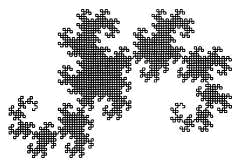
As the end of the semester approached, the class was tasked with reflecting upon our own growth and understanding of the course as a whole. From the very beginning of the semester, we looked at fractals and how they interacted, beginning with a read of African Fractals Modern Computing and Indigenous Design by Ron Eglash. Initially, I was curious to see how fractals interacted with African-American literature. I had worked briefly with fractals in my high school geometry class and had experienced them while reading Michael Criton’s novel Jurassic Park. Jurassic Park is a science fiction novel that features a cautionary tale about scientific advancements, more specifically genetic engineering. The story tells the creation and inevitable collapse of a park filled with scientifically engineered dinosaur clones. The dinosaurs escape their enclosures and chaos ensues. The book chapters are told in iterations of a fractal called the dragon curve, as shown below. Each iteration shows the park delving deeper and deeper into chaos and disrepair. 

(Photo credit: TyrannasaurTJ)

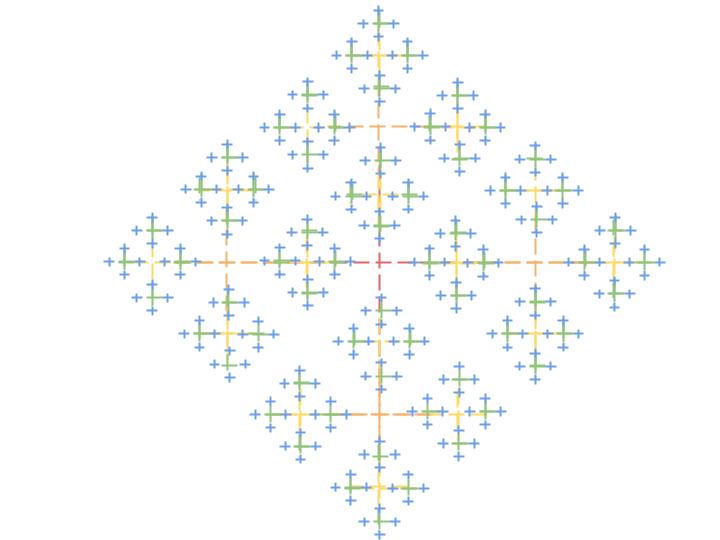
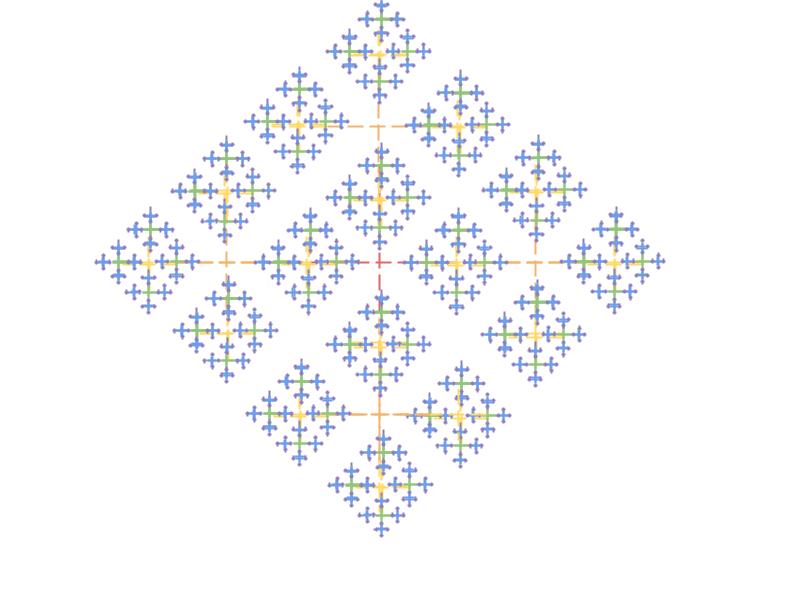
The novel’s approach to fractals inspired me to look at this course through the lens of a fractal shape. In this, I consider each module an iteration of the seed shape “thinkING, conversING, considerING, reflectING” or the course process. As each module looks at a different set of media and topics, it builds from the ones prior. The modules were all built with the process embedded into them, meaning that without the process the course likely would not work. Our instructor, Beth McCoy emphasized “thinkING, conversING, considerING, reflectING” ensuring that the class stayed on topic and properly gave every work its consideration. To properly analyze the course as a fractal design, I decided to create my own seed shape using Google Drawing and the draw line tool to develop with each module. The seed shape features four lines, each one representing one of the four processes. 

***

Iteration 1:  

“Course information, policies, and other important material to get started! You’ll return to this over and over throughout the semester”

As the first iteration of the course, this module establishes the seed shape and how it will be interacted with. I demonstrated the beginning of the seed shape, providing needed information on the course including, needed books, how we would be graded, and office hours. All of Beth’s policies are laid out for the class to see and access whenever applicable. The very first item is the course epigraphs and course descriptions. In this moment, the process is established, “In this particular 300-level course, we’ll place great emphasis on *process*: thinkING, conversING, considerING, reflectING as necessary preconditions for medical school, law school, activism, beING human.” In establishing this seed shape in the first iteration, students can consider the process and implement it moving forward. It is the start of a fractal-like course, showing itself in its first iteration.

Iteration 2:  

“Here is where you can read Call and Response and The Water Cure”

The second iteration focuses more on providing information in the manner of resources. The books Call and Response and The Water Cure by Percival Everett are provided in .pdf files. Professor McCoy explains that “Within the last year, both Call and Response and Percival Everett’s The Water Cure have gone out of print. This creates a both/and: You both get access to these works for free, and you have to cross-check these .pdfs” (McCoy). In explaining this, we see the transparency policy established in the last iteration is built upon. This iteration allows students to begin the process, as without the resources, thinkING, conversING, considerING, reflectING would be rather difficult to achieve. This iteration shows the fractal’s growth, as well as the course’s.

Iteration 3:  

“Key Concepts”

As the iteration that begins with the first week of classes, establishing a starting point while building off the first two iterations is key. The course structure is established here, as well as a reminder of one of the epigraphs stated in the first epigraph. This iteration builds off of the epigraphs, beginning the classwork involving African Fractals and Call and Response. Here we find the use of thinkING and considerING. The class begins to connect concepts of fractals to themes in African-American literature and repetition in the culture. However, we discuss the importance of not making immense generalizations, utilizing the reflectING part of the seed shape. Finally, we utilize conversING in the manner of class discussions. These can be as a whole, or in small groups, analyzing parts of the readings and how we interpret them. The seed shape repeats itself, adding more to the fractal shape. 

Iteration 4:  

“Noticing the Depths”

The fourth iteration features yet another course epigraph from the first iteration. Building off the last iteration, this module focuses on growth. As Professor McCoy notes, “This module enables you to apply and practice concepts from Module 3. In doing so, you may notice that things are more complicated than they may at first seem.” The focus seems to be on truly thinkING and considerING. However, a look at the notes from class on February 9th reveal another consideration of conversING. Without participation, conversations run dull and awkward. However, another consequence is the lack of true reflectING. If only one voice is heard, then the views are limited and biased. To work as a whole class is to truly interact with the process. The iteration can only show the addition of the seed shape with the proper conversation. 

Iteration 5:

“Integrative Inquiry, Sustainability, and Collaboration”

An iteration focused on three concepts develops upon the works used in the previous iterations. In this module, work was done on the Collaborative Exercise, where we were grouped together to answer the prompt on sustainability and Ralph Ellison’s Invisible Man. We were also encouraged to include poetry regarding sustainability and think back on the visit the class made to the college’s heating plant from the last iteration. A collaborative exercise demonstrates the process as it requires students to think thoughtfully about the prompt, reflect on how it all ties together, converse with one another in order to answer the question, and consider feedback from peers and each work individually. This iteration works to build off of the work done in previous iterations to create the newest addition of the seed shape.

Iteration 6:

“Criticism, Theory, and Poetry are the works of complicated human beings”

Once again, we begin the iteration with reminders of two epigraphs from the first iteration, demonstrating the repetition seen in fractals. The module worked with comparisons and both/and exercises. We looked for similarities and differences in works, and carefully navigated through opposing essays from Joyce A. Joyce and Henry Louis Gates. Emphasis on slowing down to truly work through the process was given. In slowing down, we were able to truly apply the process to the works, giving them the time they needed to truly find the things we liked and disliked and why. While thinkING, conversING, considerING, reflectING we were able to work through these concepts as well as get through Thomas Jefferson’s Notes on the State of Virginia. While working through this work, we acknowledged that it was both racist and important, as Jefferson was a complex person. This reading was set to establish the beginnings of the next iteration, sewing seeds within the seed shape.

Iteration 7:  

“Endings that aren’t endings”

This final iteration, appropriately titled “Endings that aren’t endings” begins with Percival Everett’s The Water Cure. Professor McCoy begins with the statement, “In this module, you’ll return all the way back to the very beginning of the course–including to “On Repetition in Black Culture” and to African Fractals–even as you read the semester’s final literary work: Percival Everett’s The Water Cure. We’ll talk about beginnings, middles, and endings. And you’ll liberate yourself from the class.” As the final iteration, it is imperative that considerations are made to the first one. As the class worked through the novel, encouragement was made to consider the past works, to reflect on what we thought and how interacting with the novel made us feel, to think beyond what was just on the page, and to converse with one another on our findings and interpretations. Without this process, navigating through the novel would have been a much different experience. Every experience we had before enabled us to interact with The Water Cure in a more careful and considerate method. As the course comes to a close, the seventh iteration shows the fractal we created.

***

As a class we discussed whether or not we thought ending the class with reading The Water Cure was appropriate. A majority argued that it was, deciding that every module before was established to prepare us for the novel. I could not agree more. Without our careful work with the process throughout this semester, navigating the novel truly would have been much different. Having the course focus on thinkING, conversING, considerING, reflectING, and using the process with every module, we were able to become comfortable with it. We could implement it without much issue. However, I must divulge a word we also worked with in conversation: apophenia. This is the habit of finding connections or patterns between unrelated or random things. Professor McCoy has worked with this word in both this course, and one I took with her prior based on Expulsion and the 2018 Housing Crisis. While I was able to find the connections between each module, and therefore apply them to the iteration concept, there is the risk that I am assigning meaning to something unintended. Regardless, I find that in my own reflection of the course the process has allowed me to find a deeper understanding of African-American literature and given me the opportunity to engage meaningfully with my peers.

Works Cited

Eglash, Ron. African Fractals: Modern Computing and Indigenous Design, Rutgers University Press, 1999. 

Everett, Percival. The Water Cure. Graywolf Press. 2007. Percival Everett, The Water Cure. 

McCoy, Beth. ENGL-337-01: African-American Literature. 2023-2024

Unpacking Complexity: Reflecting on African American Literature through ‘The Water Cure’ and ‘African Fractals’

Sophia Olechowski 

Iterations Final Essay

African American Literature 

4/29/2024

At the beginning of the semester, I thought I was fully prepared for the literature that I was going to see in this class. Having a small background in African literature classes and even my 19th century women’s work course where we read Incidents In The Life of A Slave Girl by Harriet Jacobs, I was confident that we would be reading work I was somewhat familiar with and concepts I had dealt with before. After browsing the Brightspace, before class began, I could see how Call and Response and African Fractals had fit into my expectations of what the course was going to look like. However, I could have never predicted a trip to the heating plant, nor could I have placed how The Water Cure was going to fit into the coursework. I’m sure I would have found the literature very interesting if I had fully read it in the beginning of the semester, but I would have had no idea how it connected to the concepts associated with this class. Throughout this semester, I have learned the power of slowing down and paying attention. By connecting each piece of literature to the next, collaborating with my peers, the feedback on my essays and being pushed to participate in class discussions; I have become a more attentive reader and writer. 

When we got to our first essay, based on the seed shape brought up by Ron Eglash in our first book African Fractals: Modern Computing and Indigenous Design, I thought I fully understood the concept. In my original interpretation, I viewed the seed shape and the concept of African fractals as two separate entities. Instead, I should have made it clear that the seed shape is the first iteration for a fractal and when you begin to repeat the iteration over and over, it becomes a fractal. This small detail would have not only made it more clear what the seed shape actually was; it also would have made my arguments stronger. As I analyzed “Everyday Use” by Alice Walker I took a closer look at the main character Dee and her mother as the narrator; claiming “it is crucial to recognize the limiting perspective of Dee’s mother that has been influenced by her own experience and trauma; and how Walker chooses to show this,” (Olechowski, Exploring the Seed Shape). I reflect on the traumatizing past Dee’s mother endured in order to present her as an unreliable narrator. By recognizing the seed shape as the initial building block of a fractal, I would have laid a stronger foundation for my arguments about the importance of understanding the seed shape before reading African American literature. Jumping to the end of the semester, the same concept was brought up when talking about The Water Cure and its narrator, Ishmael Kidder. 

As Kidder struggles with the loss of his daughter, it is unclear as to whether the story he is telling is even true. Constantly questioning the validity and authenticity of the authors and characters in our readings propelled a clear concept in African American studies. Due to the prevalence of Eurocentric tendencies, especially here in the United States, engaging with this literature requires more than just looking at the words on the page. It requires a deep dive into the cultural and historical contexts that shape African American narratives, characters and themes in these works. Take The Water Cure for instance, from the rambling words, sentences with scrambled letters and drawing thrown in throughout, the book truly looks like a mad man’s brain. Without the mini collaboration project and the conversations we had in class, I would have had a much harder time truly understanding the story and how it fit with what we had previously read. 

Upon first reading The Water Cure, I would have never thought to connect it back to Thomas Jerffersons “Query XIV,” given their complexities and contradictions. In Thomas Jefferson’s “Query XIV” he describes someone who is carefree and creative and whose writing is unrestrained, “his imagination is wild and extravagant, escapes incessantly from every restraint of reason and taste, and, in the course of its vagaries, leaves a tract of thought as incoherent and eccentric, as is the course of a meteor through the sky,” and makes it clear this person is not African American (Jefferson, Query XIV). The discussion my group had for the mini collaboration helped me to explore themes of restrained versus unrestrained art, drawing on parallels between Jefferson’s depiction of creativity and his lack of confidence in African Americans to produce creative works. Our discussion led us to a point where we concluded that while African American writers face external and internal constraints and expectations, their creativity and expression can go beyond these limitations. Not only did I make great connections with my peers, but Professor McCoy also played a crucial role in pushing me further in class. 

  After reading The Water Cure, our class found it insightful to talk about the drawings throughout; I commented that the simplicity of them was ominous and creepy. That was the full extent of my thought, but Professor McCoys questions connecting back to Thomas Jefferson prompted me to think about why Percival Everett chose to depict his art this way. It became clear that Everett had read Jefferson’s words claiming African Americans could not even make elementary art, yet Everett produces not only that but also a story filled with seemingly unrestrained and chaotic writing and telling a beautiful story of a man lost in grief. While being prompted to elaborate on my thoughts spontaneously in front of the class is usually anxiety-inducing for me, Professor McCoy’s consistent emphasis on independent THINKing among students proved to be very beneficial to me. Overtime, her reminders empowered me to develop my own perspectives, even if I still had questions to ask. Eventually, her presence became almost inconsequential, allowing the students to engage in meaningful discussions independently and push ourselves and each other to think deeper.

I’ve come to realize that literature and discussions that push us out of our comfort zones or make us slightly uncomfortable are often the most impactful for learning and personal growth. The discussions we had in class, particularly regarding literature and art that initially seemed unconventional or confusing, taught me the value of embracing complexity and ambiguity. 

As I mentioned earlier, the words on the page of African American literature are steeped in historical and cultural contexts. When one can understand these contexts, the literature begins to connect in ways you did not see before. Just like with my experience reading The Water Cure and examining “Query XIV,” I found it necessary to methodically unpack the historical backlash against African Americans by white people. This process helped me grasp the underlying context behind Percival Everett’s writing. My initial reads of each were approached very timidly, as I had heard “just give it the old college try” from a few professors regarding more intricate or dense literature. At the beginning of the semester, this scared me. But after reading through all of that literature and taking the time to engage in meaningful conversations about them, I learned that my abilities were far beyond what I had originally thought. 

Professor McCoy’s emphasis on independent thinking and her encouragement to tackle challenging material with confidence have been instrumental in shaping my approach to literature and class discussions. One key lesson I’ve learned is the importance of slowing down and paying attention to every detail. This became evident when I received feedback on my seed shape essay, where I used diction that didn’t accurately represent my intended message. It was a reminder to be more mindful and deliberate in my writing, ensuring that my words truly reflect my thoughts and arguments. This lesson was also reflected through our study of paratexts and in depth studies and discussions on the authors we were reading in class. Overall, this class has not only deepened my understanding of African American literature but has also expanded my confidence in engaging with complex themes and concepts. 

Recursion Final Essay

Throughout the course of the semester, we have studied a number of different works. Finding one text that adequately wraps up all that we’ve been learning is almost impossible. However, The Water Cure by Percival Everett is a novel that encompasses what we’ve been learning in our course and functions well as a final text. The main reason that The Water Cure works so well as our last text is because of the recursion that is evident throughout the novel. Throughout the novel, Percival Everett uses a looping narrative to create a sense of repetition and circularity. This is something that we have been studying and practicing throughout our course. For example, African Fractals. An African Fractal is a pattern that takes on the form of a seed shape. This seed shape pattern is something that will always reoccur. Although the pattern becomes smaller as it grows, the pattern will never stop recurring and is infinite. The Water Cure is a novel that embodies the same concept of recursion as seed shapes. The recursion that happens in the novel and in seed shapes is similar to how our course is structured. Learning how to be able to loop back to concepts and connect them to different works is the biggest way I have grown as a student in this course. This is why The Water Cure serves as a great final text because it symbolizes my semester’s final story by its recursion. 

            There are many examples of recursion throughout The Water Cure by Percival Everett. The first place that recursion appears is in the narrative format itself. The narrative often circles back to certain elements in the story, giving the reader a sense of recursion. The story is centered around Ishmael Kidder, a man who lost his daughter to murder. Throughout the narrative, we are questioning if Ishmael has who he believes to be his daughter’s killer locked in his basement. The reason we are left to question if Ishmael Kidder has someone locked in his basement is because of the way Percival Everett writes the story. Everett does this by telling multiple story lines at once and shifting between the past and present. For example, there is a flashback that says, “It was cloudless and sunny the day Charlotte and I brought Lane home. Shewa’s small, they said, five pounds, but not that small, they said, but I had never seen anything so small. I took it on faith that those little fingers were completed with nails and the very suggestion that they be trimmed with something sharp sent me into a panic. A nurse had seen me studying them, one nail at a time, especially the little toes, and she, being one of those people who find comfort in nervous chatter, said, ““Just wait until you have to cut them..”” This flashback talks about the day Ishmael brings Lane home from the hospital as a bay. However, as we know Lane dies before the start of the story. The next page of the text says, “Secretary of State: Pull my finger..

President: Okay.

I can do what I like at any moment I like in this document or text or however we name it because this is my world, universe, neighborhood, note ((though I hate seeing the word note in my notes), and I can do what I damn well please and fuck you if you think I’m ignoring rules and fuck you if you think that I’m being indulgent and fuck you if you think that references to archaic philosophical notions are mere erudition, which they are not, but fuck you anyway because this is my world and you’re welcome to it if you want to enter and if you don’t want to enter then fuck you twice anyway and if you do want inside then fuck you trice because you fucking deserve it.”. This shows how in the story the narration changes from flashback to present tense. The page before this it was talking about Lane coming home for the first time and then the story jumps to Ishmael being angry because she is dead. This is an example of the recursion that happens within the story because it is not linear. It goes back and forth between past and present. This is similar to African Fractals because they also reoccur. They keep the same shape going over and over again just as The Water Cure goes from past to present over and over again.

Another example of recursion in The Water Cure is the number of times a word or phrase is repeated within the novel. For example, one page of the text says, “The words on these pages are not the story. The words on these pages are not this story. The words on these pages are the words on these pages, not more, not less, simply the words on these pages, one after another, one at the beginning and one at the end, bearing possibly some but probably no relation to each other, but they can, if you desire to find a connection, need to, or if it irresistibly, axiomatically, ineluctable reveals itself to you. When you leave, desert these words, the words on these pages, you might use words very much like these to report what meaning you have found, but not these very words. You perhaps will leave these pages, the words on these pages, with an idea or two and maybe, just maybe, the order of a few of these words and so it goes.” The repetition of “the words on these pages” reminds me of African Fractals because of how they repeat as well. This relates to how I feel about our course. Repetition is something we have talked about plenty during this semester. For example, rereading texts, going back to look at older texts we have read, and going over assignments with feedback. Repetition is something that I have taken into further consideration after this semester because it is very important to look back on old texts and concepts and be able to connect them to other texts. 

The final thing that connects African Fractals and The Water Cure is that both don’t have an ending. African Fractals are mathematical equations that continue in the same pattern without stopping or changing. The Water Cure is also a novel that is left open-ended. The fate of the characters is left up to the interpretation of the reader. Ishmael is still left questioning his life. The final lines of the novel are “I ask only to find the answers I need, but then there are the other questions: Will my daughter grow older in my dreams? Why do reasonable people entertain the ontological l argument? and What kind of dog was it? And the answers are: No, Because they can, and Some kind of retriever.”. This shows that there is no real ending because Ishmael is still left with questions. This is why I think that The Water Cure is a good text to use as our final text for our course. It is left really open ended which I think is how a college course should end because we are never done learning, just as African Fractals never end either.  

Iterations Final Reflection Essay

Such an ambiguous statement as restrained, has many different meanings. According to  the Cambridge Dictionary, restrained means “acting in a calm and controlled way.” But, it can also mean something else, such as “something that is kept under control, such as a strong emotion or even physical movement” (vocabulary.com).

In the novel The Water Cure restraint is a recurring theme in Percival Everetts’s work, manifesting in various forms across the expansion of the novel, challenging readers to explore the complexities of human experience and society. His skillful use of restraint adds depth and resonance to his writing.

In The Water Cure the term “restrained” is applied literally to the victim “Art.” The victim is called “Art” by his captor, Ishmael Kidder. Art may or may not be restrained by his captor Ishmael, and held within his basement throughout the novel. “Art is tied up down in my basement and will never again see the sun, will never smell a flower again, will never feel the rain, hear the wind, touch a puppy or a child” (Everett 36). Due to Art being “tied up,” Art’s physical movement was restrained. This concept of restraint relates to the definition provided previously, “something that is kept under control, such as a strong emotion or even physical movement”.

In “The Water Cure,” the term “art” undergoes a metamorphosis, adapting to the diverse contexts in which it is invoked. On one hand, there is “Art” the person, a mysterious figure whose presence looms large over the narrative, potentially subjected to capture and restraint. On the other hand, there is “art” in its traditional sense, embodying the essence of creative expression and imagination, often manifested through visual mediums like painting, sculpture, or drawing. This duality underscores the thematic exploration of control, constraint, and the blurred boundaries between freedom and captivity within the novel. Within The Water Cure, Kidder draws a picture of his daughter Lane. The portrayal lacks intricate detail, rendering it akin to the work of a child of merely five years old (Everett 28). Kidder’s struggle to fully depict Lane in his drawing symbolizes more than just artistic limitations; it embodies his psychological and emotional state, constrained by the specter of impending tragedy. His grief manifests in uncontrollable behaviors, further restricting his ability to articulate his emotions and represent his daughter accurately. In this way, the act of artistic expression becomes entangled with themes of restraint and loss, highlighting the profound impact of emotional turmoil on creative output.

In the context of “The Water Cure,” Ron Eglash’s exploration of African Fractals in his book “African Fractals Modern Computing and Indigenous Design” provides a fascinating parallel to the themes of restraint and limitation present in Percival Everett’s novel. Eglash explores the intricate world of African fractal geometry, examining its cultural significance and the political implications embedded within its study. One of the key aspects discussed is the politics surrounding African Fractals and the constraints imposed upon them.

Upon Eglash speaking with chaos theorist Ralph Abraham, he explained that “analog systems were in his view the realm of spirit, the vibrations of Atman ” (193). In contrast to this theory, James Clifford insisted that only “digital representation is capable of the flexible rearrangements that constitute human thought” (193). This battle between theories has been played out in the history of African culture studies. In the 1960s realism was vogue, and what could have been a wonderful exploration of the analog representation techniques in African culture, “was often reduced to romantic portraits of the ‘real’ and ‘natural,’ while African symbolism systems suffered from neglect” (193-194). This clash of theories mirrors a historical struggle within African cultural studies, where differing approaches have shaped perceptions of African representation techniques. In the late 1970s, this began to reverse itself with the escapade of postmodernism. African culture portraits became increasingly focused on discourse and symbol systems, “even at the expense of ignoring analog representations” (194).

The constraints imposed upon these romanticized portraits echo the limitations faced by Kidder in portraying his daughter in “The Water Cure.” Both forms of representation are hindered in their own ways, ultimately failing to fully realize their potential. Kidder’s portrayal of Lane lacks detail, reflecting his emotional turmoil and the overwhelming fear of loss. Similarly, the reductionist approach to African representation overlooks the complexity of analog techniques, restricting the portrayal of cultural richness and diversity.

The restrained aspect of both books connects to the experiment run during class relating to Zeno’s paradox, the dichotomy. The paradox of dichotomy addresses the idea of reaching a distance through a series of continuous divisions of space and time. For example in the experiment in class, there was a group of 5 students with a destination in front of them of 5 Pikachus. The goal was for them to reach the Pikachus but with each step, they must go halfway. It goes as follows, suppose you want to walk from point A to point B. Before you can reach point B, you must first reach the midpoint between your starting point and the midpoint, and so on. In other words, to cover any distance, you must first cover half of that distance, and then half of the remaining distance, and so on, resulting in an infinite number of steps. Zeno argued that since an infinite number of steps cannot be completed in a finite amount of time, motion is therefore impossible. The concept of going halfway implements a restriction on the person trying to reach the destination, as reaching the destination becomes impossible. 

In Zeno’s paradox, the idea of motion is challenged by the notion of continually dividing space into smaller and smaller increments. This concept connects the “The Water Cure ” as the character Art as well as Kidder himself experience a sense of constraint and limitation on their abilities. Kidder’s portrayal of his daughter Lane, lacks detail due to his emotional turmoil and fear of loss, showing that personal restraints can impose on artistic expression. This also connects to Art’s physical restraint as his physical abilities may or may not be restrained. In a similar connection, the reductionist approach to African representation discussed in the context of Eglash’s exploration of African Fractals correlates to the infinite division shown by Zeno’s paradox. Furthermore, just as dividing space into infinitely smaller parts lends to an infinite series of steps, reducing African representation to simplistic portrayals overlooks the richness and diversity of the culture, restraining our understanding of it.

In conclusion, the dive into the concept of restraint in “The Water Cure”  and the examination of African Fractals in Eglash’s work offer profound insights into the complexities of human experience and cultural representation. Intertwined in these narratives we confront the concept of restraint, which can manifest in different forms. These restraints imposed upon characters and cultural representations echo the limitations faced by individuals in expressing themselves. 

Furthermore, the connection to Zeno’s paradox of Dichotomy illuminates the influence of restraint in shaping our understanding of time and space. Similar to Zeno’s paradox, the characters in “The Water Cure ” and the representations of African Culture, challenge the possibility of motions through continuous division. Whether through personal or societal restraints, the theme of restraint serves as a powerful lens through which to examine the human condition. 

Ultimately, the exploration of restraint in literature and cultural studies entices us to reflect on the way in which restraints shape our perceptions and experiences. But by confronting these restraints, we can strive towards a better understanding of ourselves and the world around us. 

Iterations Final Reflection Essay

Throughout this semester, as we’ve talked in class and read our books, I’ve learned a lot about African American literature and how it shaped the world today. In the very beginning of the semester, we started with “African Fractals” by Ron Eglash, which talked a lot about geometry, architecture, scaling, and how they intertwine in many different ways. Later on, at the end of the semester, we read “The Water Cure” by Percival Everett, which had themes of revenge, malice, and renewal. These two books by themselves seem to have hardly anything in common, but upon further inspection, it becomes clear that we read them for a reason. The lessons I’ve experienced during this course taught me how to bring these books together. Looking back on everything, I can see I’ve learned a bunch about what this class is trying to teach us, and I feel like I’ve gained a vast amount of knowledge I was previously not exposed to.

To start, “African Fractals” delved into the ideas of geometrical architecture, or fractal architecture. Fractals can best be described as a curve or geometric figure, each part of which has the same statistical character as the whole. Using this in architecture gives the buildings a uniquely constructed pattern. The purpose of the geometry shows how cultures produce recursive patterns that characterize their specific social, cultural, economic and political organization. This means that the designs in architecture aren’t just about looks; they also reflect how societies are structured and organized. For example, certain fractal patterns might represent social hierarchies or economic systems within a culture. So, understanding these fractal patterns helps us understand more about the people and societies that created them. Moreover, fractal architecture serves as a manifestation of cultural identity and values. By employing fractal geometry in their architectural designs, different societies express their unique worldview and beliefs. For instance, a culture that values harmony and interconnectedness may incorporate fractal patterns that emphasize repetition and symmetry, reflecting their emphasis on unity within the community. On the other hand, a society that prioritizes individualism and innovation might utilize fractal designs that showcase complexity and diversity, symbolizing their embrace of individual expression and creativity.

In “The Water Cure” by Percival Everett, we meet Ishmael Kidder, a writer who lives by himself after his divorce. His world is shattered when he learns about the brutal murder of his daughter. Fueled by grief and a desire for justice, Kidder embarks on a quest to find the person responsible for his daughter’s death. When he finally tracks down the culprit, Kidder takes matters into his own hands by kidnapping him and keeping him captive in his basement. Since Kidder never learns the man’s name, he simply refers to him as Art. Over the course of several days, Kidder subjects Art to various forms of torture as he seeks retribution for his daughter’s untimely demise. However, as the story unfolds, Kidder’s actions raise questions about morality, justice, and the nature of revenge. In the end, Kidder makes a surprising decision to release Art, leaving readers to ponder the complexities of human emotions and the consequences of seeking vengeance. 

Both “African Fractals” and “The Water Cure” explore the interconnected themes of geometry and renewal in different contexts. In “African Fractals,” the focus is on the use of geometric architecture, particularly fractals, as a reflection of societal structures and values. The way in which different societies utilize fractal geometry in their architectural designs reflects their unique social, cultural, economic, and political organization. For example, certain fractal patterns may represent social hierarchies or economic systems within a culture. By understanding these fractal patterns, we gain insights into the people and societies that created them. Moreover, fractal architecture serves as a manifestation of cultural identity and values, with different societies expressing their worldview and beliefs through their architectural designs. This connection between geometry and culture highlights the role of architecture as a means of expressing and perpetuating societal norms and values. Similarly, in “The Water Cure,” the themes of geometry and renewal are explored through the actions of Ishmael Kidder. Kidder’s quest for justice following the murder of his daughter leads him to engage in acts of violence and revenge. However, as the story unfolds, Kidder’s actions raise questions about morality, justice, and the nature of revenge. His decision to release the man responsible for his daughter’s death reflects a moment of contemplation and renewal. Kidder struggles with the consequences of his actions and ultimately chooses to break the cycle of violence, offering a chance for redemption and healing. This moment of renewal emphasizes the complexity of human emotions and the potential for growth and transformation, even in the face of tragedy. In both cases, geometry serves as a metaphor for the underlying structures and patterns that shape human behavior and societal dynamics. Through the exploration of these themes, both “African Fractals” and “The Water Cure” invite readers to reflect on the interconnectedness of form and meaning in the world around us, and the potential for renewal and growth even in the most challenging circumstances.

Finally, connecting this to my class experience, the exploration of geometry and renewal as depicted in “African Fractals” and “The Water Cure” resonates with my own journey of learning and growth . Just as fractal geometry in architecture serves as a reflection of societal structures and values, my study of literature, mainly African American literature, has offered insights into the underlying patterns and dynamics of human society. Through discussions, readings, and assignments, I have gained a deeper understanding of how cultural, social, and historical factors shape individual behavior and collective identity. Moreover, the themes of renewal and transformation depicted in “The Water Cure” are similar to my own experiences of personal growth and development throughout the semester. Like Ishmael Kidder’s journey towards redemption, my academic journey has involved moments of reflection, self-discovery, and renewal. I definitely have encountered challenges and setbacks along the way, but through perseverance and reflection, I was able to overcome obstacles and emerge stronger and smarter. Overall, the themes explored in “African Fractals” and “The Water Cure” served as metaphors for my own educational journey, highlighting the interconnectedness of learning, self-discovery, and societal dynamics. As I continue in my academic pursuits, I will find inspiration in the patterns and possibilities of growth and renewal, both within myself and in the world around me.