
In her work “Elements of Style,” writer Suzan-Lori Parks discusses the intricate relationship between form and content both in writing and in life. Parks states that “content determines form and form determines content; that form and content are interdependent.” (Parks, 7) This chiasmus creatively asserts that form and content are dependent on each other. This complex concept is difficult to comprehend at first, however, Parks relates this concept to entities outside of writing. Interestingly, Parks uses her physical body as an example of a form and how the content of her life is dependent on her physical form. She writes, “It’s like this: I am an African-American woman – this is the form I take, my content predicates this form, and this form is inseparable from my content. No way I could be me otherwise.” (Parks, 8) By explaining the relationship between form and content in this way, Parks allows her audience to connect this idea to their own lives. Continue reading “The Interdependence of Form and Content”
Part of the Story
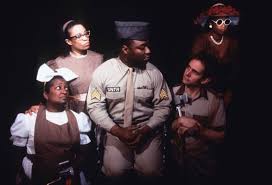
As we have discussed in class, Toni Morrison’s Jazz ends with a line that reads, “Look where your hands are. Now.” By ending her book in such a way, Morrison is acknowledging the reader, letting them know the uncomfortable reality that they are not as far removed from the narrative as they may believe. Usually, when one reads a book watches a play or engages in any other form of media they are observing it through the eyes of the protagonist, a safe, comfortable lens, where they are just out of reach of the events taking place. Continue reading “Part of the Story”
What’s in a name?
The other day when discussing Suzan-Lori Parks’ Imperceptible Mutabilities, Dr. McCoy gave us a Latin phrase to help us understand the name change that occurs in the characters. This phrase is mutato nomine de te fabula narratur which means with the name changed, the story applies to everyone. I have been noticing things in Big Machine regarding the character’s names and once receiving this phrase I decided it was finally time to unpack the significance behind all these names. Continue reading “What’s in a name?”
How often do you judge a book by its cover?
As a child, one of the first things I was taught was, don’t judge a book by its cover. It is one of those metaphorical phrases, that has been engraved in my mind my whole life, which provoked me to do some research on why humans judge in the first place. Continue reading “How often do you judge a book by its cover?”
How Do Institutions Fail You?
Throughout the semester, we talked about how institutions fail us, whether it is related to academia or something on a larger scale. This concept came up again on Friday as we were discussing as a group what our favorite quote from Big Machine was. Personally, I had said that my favorite quote was “AND YET, no matter how earthshaking a moment is, there’s that minute right afterward when you return to the unconcerned world” (page 246). The reason I had chosen this quote was that as a college student, my world can feel like its collapsing with every poor grade, overcommitment, and constant pressure to succeed. However, things always seem to pan out, and if it doesn’t, life isn’t over and we return to reality….failure is inevitable and we must keep moving forward. As we went around the seminar circle I formed a liking for a quote that Courtney Statt had delivered to the class as her favorite from Big Machine, “The dread you feel when institutions fail you” (page 290). I fell in love with this quote at that moment, it was like love at first sight. I began to think about our discussion earlier this semester when we discussed how much we trust our institution to take care of us, and I decided to turn to my peers for more input on this discussion.
Tell your story. Or they will tell it for you, and it will not be the right one.
*Warning: This blog post contains strong language
After reading Emily Tsoi’s blog post “The Necessity for Diversity in Children’s Literature,” I was reminded of a conversation I had with my AP Literature teacher during Spring break.
Continue reading “Tell your story. Or they will tell it for you, and it will not be the right one.”
Hope, Doubt, and Life Achievements
During class on Monday, April 22nd, Dr. McCoy asked the class to pull out a line within our reading of Big Machine that stood out to us. I originally thought to myself that this was going to be difficult due to the fact that I knew I came across many intriguing lines within the reading, however, when skimming through the pages I kept being drawn back to one particular phrase; “As a human being you tend to think your present moment is the pinnacle, the summit, of life’s achievements” (266). At first, I believed that I was attracted to this line because I related with it and believed it to be true but when I actually read this line out loud to the class and had to provide an explanation to why I picked it, my understanding of the phrase shifted. Continue reading “Hope, Doubt, and Life Achievements”
On Being Subjects
When we discussed Suzan-Lori Parks’s Imperceptible Mutabilities in class the other day, Professor McCoy told us how in the performance of the play, actors stare and single out audience members, making them uncomfortable. This was a big source of criticism for viewers, as it made them uncomfortable to be the subject when they went into the play with the expectation of watching objectively. After learning this play is a commentary on slavery, I believe the intent of this was to make viewers feel the way the Naturalist, along with white people in general, were treating and seeing African Americans as inferior subjects. Continue reading “On Being Subjects”
Trust and Doubt
As I was trying to find inspiration for my last blog post I started thinking about all the things that we have been doing in class and what would be best fit to end my last blog post. In class we have been talking about Big Machine by Victor LaValle and the class was asked to each come up with one question that we think the book seems to be raising. There was a whole range of questions; a lot of the class thought of questions that included doubt and I thought mine went along with this topic. My question was “Who can you trust in the world, or are you alone?” A lot of people seemed to rephrase this question, focusing on the word doubt instead of trust, but fundamentally asking the same concept. I feel that doubt is the exact word that I could use that would go along with my question, if I rephrased it. So far, we have only read up to chapter 78 of the 81 that is in this book and we have seen multiple characters talk about trust and doubt in a way that links them.
Consent and Male Pregnancies in Black Science Fiction
As the semester nears the end, I am finally writing about the concept of consent illustrated in Octavia Butler’s fictional short-story, Bloodchild. This blog post is long overdue, but considering how this class consists of recursion and repeated themes, I think it’s safe to say that writing about consent in any area is always relevant. Also, considering how Ricky Rice in Victor LaValle’s Big Machine experiences nonconsensual conception shows the narrative of consent that science fiction, more specifically in Afro-Futurism portrays with men.
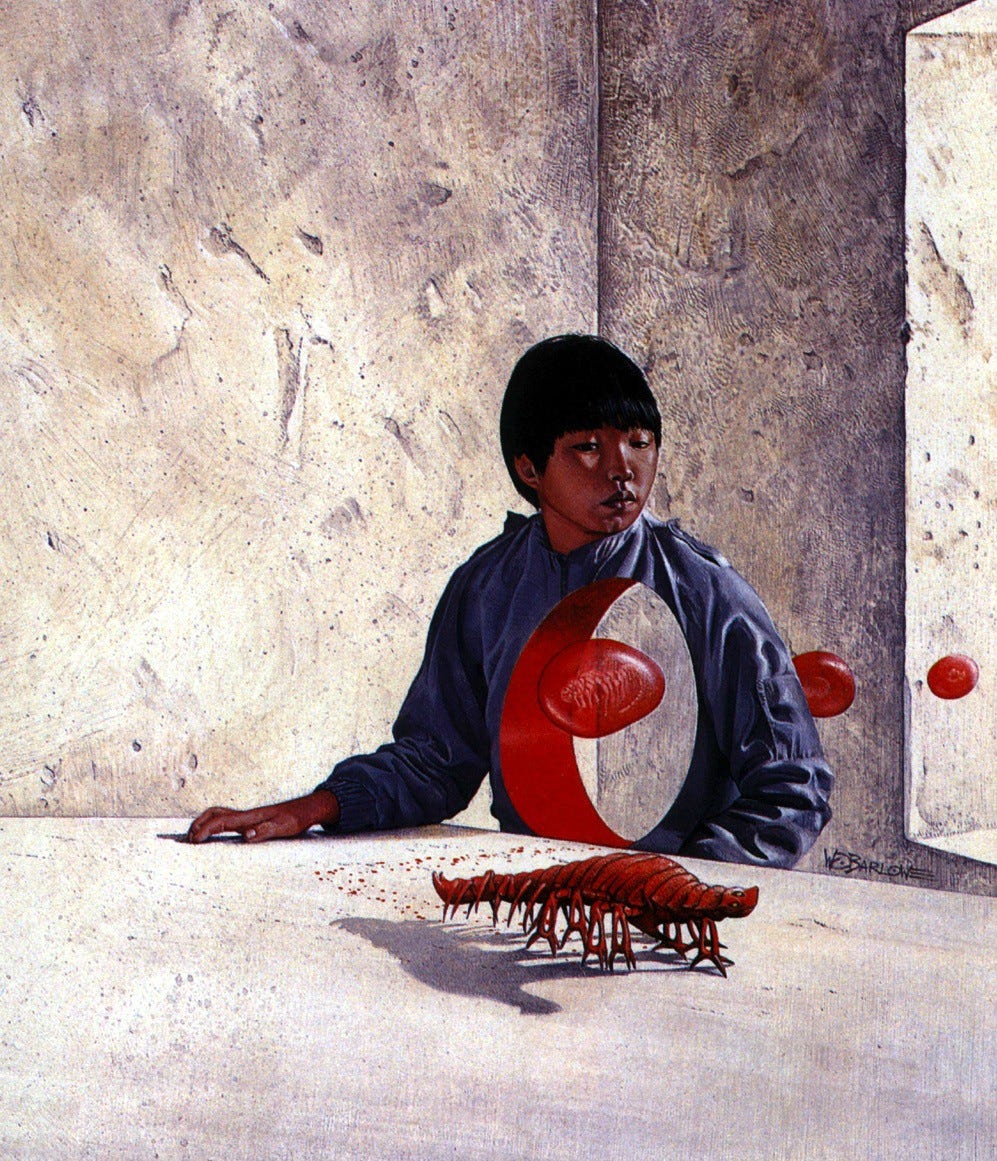
*Pictured: Assumed Illustration of Gan from Octavia Butler’s Bloodchild
Continue reading “Consent and Male Pregnancies in Black Science Fiction”